
США на порозі 250-річчя: як країна трансформувалася за останні 50 років США через 50 років: 250-річна історія змін. Подивимося, що змінилося!

- Демографічні зміни: Населення США за останні 50 років стало значно старшим, більш расово та етнічно різноманітним, а відсоток народжених за кордоном зріс майже втричі.
- Зміна структури сім’ї: Зменшилася частка дітей, які живуть з обома одруженими батьками, тоді як зросла кількість багатопоколіннєвих домогосподарств.
- Економічна нерівність: Незважаючи на зростання середнього заробітку, розрив між найбагатшими та найбіднішими верствами населення збільшився, а середній клас скоротився.
У липні Сполучені Штати відзначатимуть своє 250-річчя. Минуле велике ювілейне святкування країни відбулося 50 років тому, на її двохсотріччя 4 липня 1976 року.
Суспільство США зазнало глибоких змін відтоді. За останні п’ять десятиліть населення США значно постаріло, при цьому відсоток людей віком 65 років і старше майже подвоївся. Країна також стала більш расово та етнічно різноманітною, оскільки зростає частка людей, які ідентифікують себе як азійці або латиноамериканці. І після прибуття понад 70 мільйонів іммігрантів відсоток народжених за кордоном у населенні зріс більш ніж утричі.
Американці також рідше одружуються, ніж будь-коли раніше. Жінки, які зараз мають набагато більше можливостей поза домом, ніж у 1976 році, сприяли стрімкому зростанню вищої освіти та допомогли розширити робочу силу. І хоча багато американців мають краще фінансове становище, ніж 50 років тому, економічні розриви збільшилися.
Напередодні національного свята було виявлено деякі помітні тенденції в ключових сферах американського життя: демографія, робота, сім’я та економіка. Порівняння за 50 років базуються на даних Бюро перепису населення США, зібраних між 1970 та 2024 роками.

Демографія
Люди святкують двохсотріччя США у Бойлі, Колорадо. Понад 2100 кандидатів на громадянство США під час церемонії натуралізації у 2022 році в Лос-Анджелесі. (Tony Korody/Sygma, Gary Coronado/Los Angeles Times через Getty Images)
Населення США за останні 50 років зросло більш ніж на 120 мільйонів осіб до загальної чисельності приблизно 340 мільйонів, причому значну частину цього зростання забезпечили іммігранти, збільшення тривалості життя, а також американці азійського та латиноамериканського походження. Географічно спостерігалося значне переміщення людей до південних та західних штатів.
Старіння населення
З 1970 року частка американців віком 65 років і старше майже подвоїлася – з 10% до 18%. Середній вік зріс у всіх расових та етнічних групах, але найрізкіше він збільшився серед білих та чорношкірих американців.
Population% of total population, by age group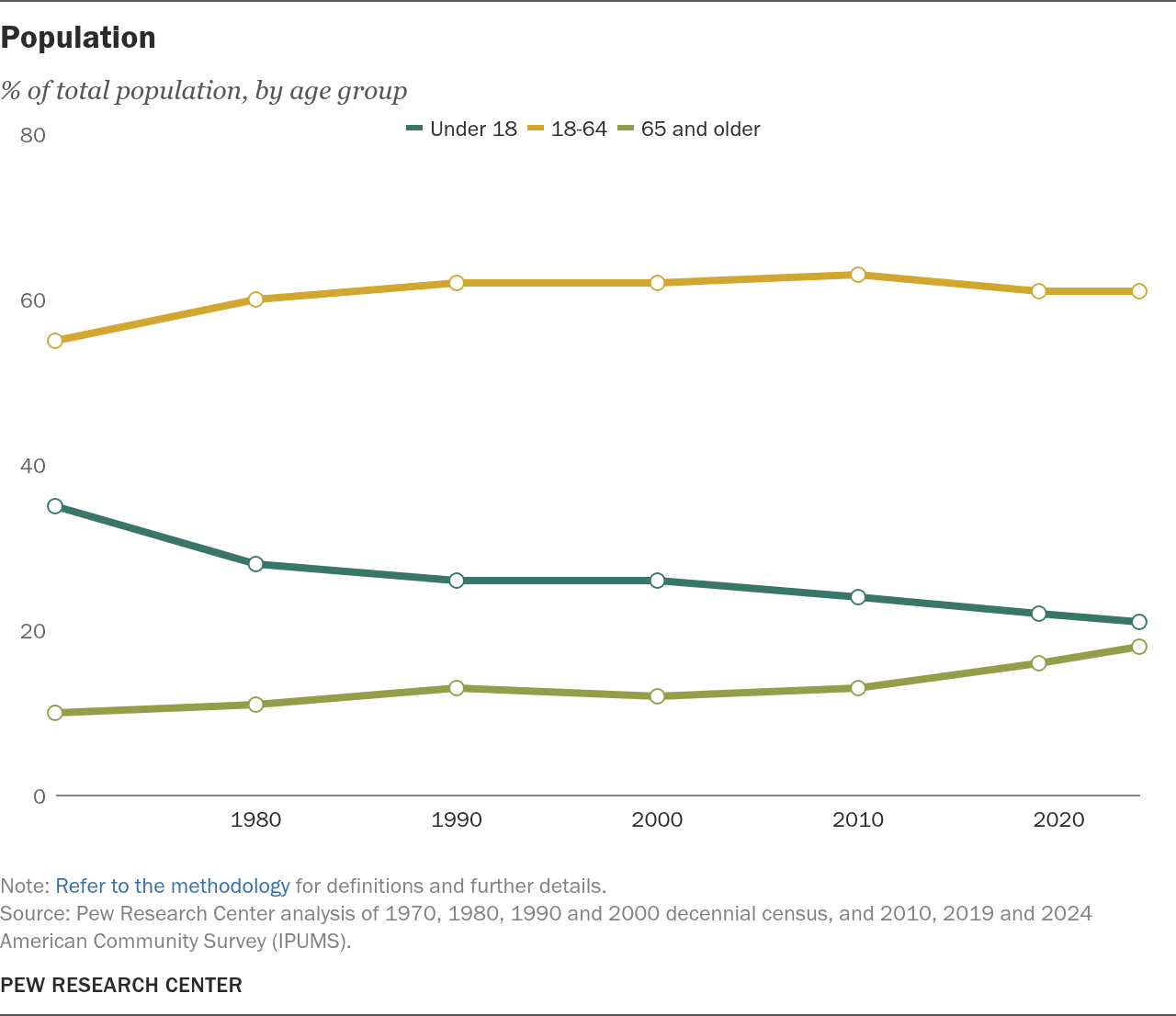 Note: Refer to the methodology for definitions and further details. Source: Pew Research Center analysis of 1970, 1980, 1990 and 2000 decennial census, and 2010, 2019 and 2024 American Community Survey (IPUMS).PEW RESEARCH CENTER
Note: Refer to the methodology for definitions and further details. Source: Pew Research Center analysis of 1970, 1980, 1990 and 2000 decennial census, and 2010, 2019 and 2024 American Community Survey (IPUMS).PEW RESEARCH CENTER
Share this chart
Population% of total population, by age group
| Year | Under 18 | 18-64 | 65 and older |
|---|---|---|---|
| 1970 | 35% | 55% | 10% |
| 1980 | 28% | 60% | 11% |
| 1990 | 26% | 62% | 13% |
| 2000 | 26% | 62% | 12% |
| 2010 | 24% | 63% | 13% |
| 2019 | 22% | 61% | 16% |
| 2024 | 21% | 61% | 18% |
Download data as .csvNote: Refer to the methodology for definitions and further details. Source: Pew Research Center analysis of 1970, 1980, 1990 and 2000 decennial census, and 2010, 2019 and 2024 American Community Survey (IPUMS).PEW RESEARCH CENTER
Median ageMedian age, by race/ethnicity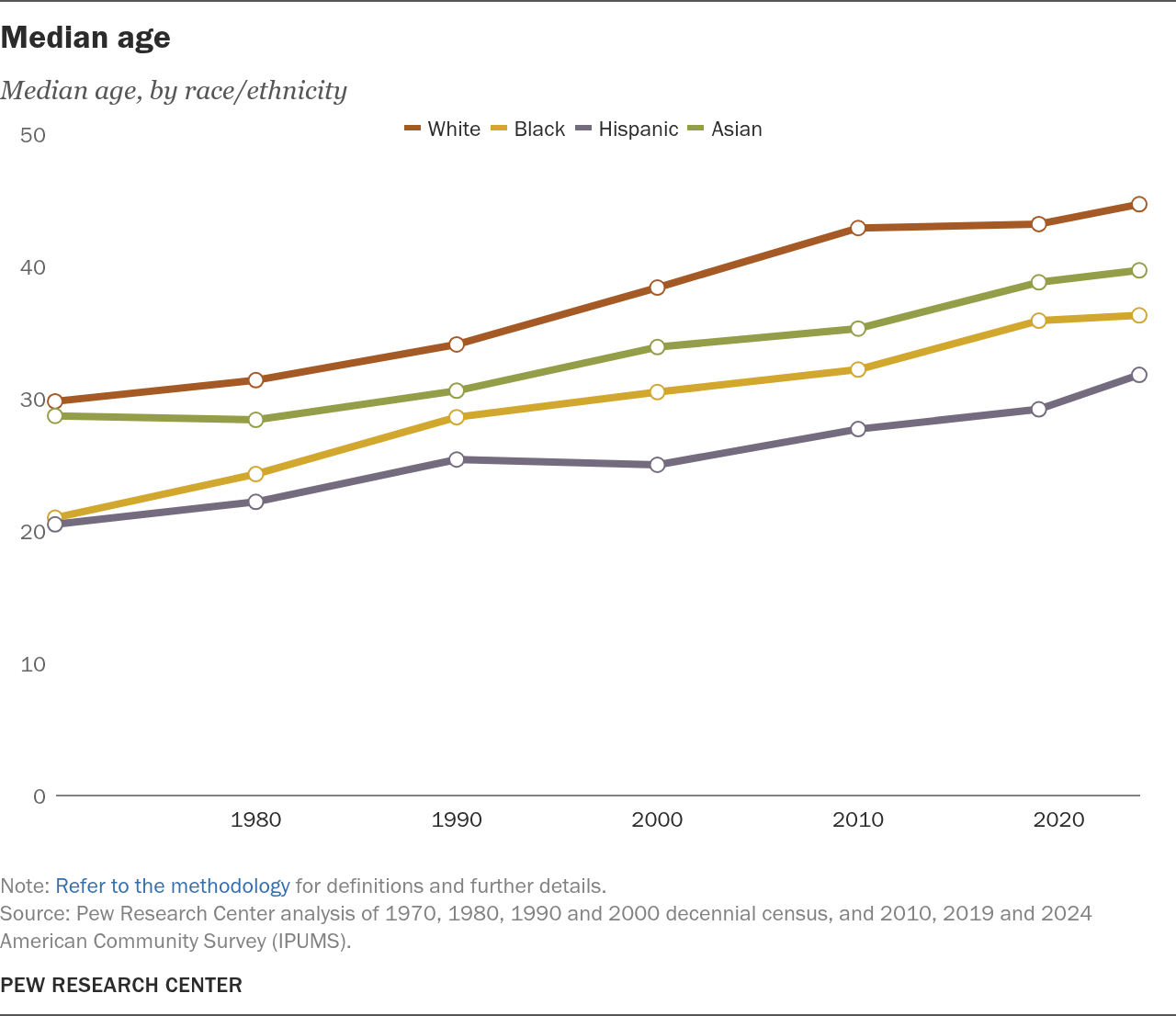 Note: Refer to the methodology for definitions and further details. Source: Pew Research Center analysis of 1970, 1980, 1990 and 2000 decennial census, and 2010, 2019 and 2024 American Community Survey (IPUMS).PEW RESEARCH CENTER
Note: Refer to the methodology for definitions and further details. Source: Pew Research Center analysis of 1970, 1980, 1990 and 2000 decennial census, and 2010, 2019 and 2024 American Community Survey (IPUMS).PEW RESEARCH CENTER
Share this chart
Median ageMedian age, by race/ethnicity
| Year | White | Black | Asian | Hispanic |
|---|---|---|---|---|
| 1970 | 29.8 | 21.0 | 28.7 | 20.5 |
| 1980 | 31.4 | 24.3 | 28.4 | 22.2 |
| 1990 | 34.1 | 28.6 | 30.6 | 25.4 |
| 2000 | 38.4 | 30.5 | 33.9 | 25.0 |
| 2010 | 42.9 | 32.2 | 35.3 | 27.7 |
| 2019 | 43.2 | 35.9 | 38.8 | 29.2 |
| 2024 | 44.7 | 36.3 | 39.7 | 31.8 |
Download data as .csvNote: Refer to the methodology for definitions and further details. Source: Pew Research Center analysis of 1970, 1980, 1990 and 2000 decennial census, and 2010, 2019 and 2024 American Community Survey (IPUMS).PEW RESEARCH CENTER
Більш різноманітна Америка
Частка білого (не іспаномовного) населення США неухильно знижується з 1970 року, тоді як частка іспаномовних зросла більш ніж у чотири рази. Білі американці зараз становлять близько половини населення або менше в Південному та Західному регіонах.
Race and Hispanic origin population% of total population, by race/ethnicity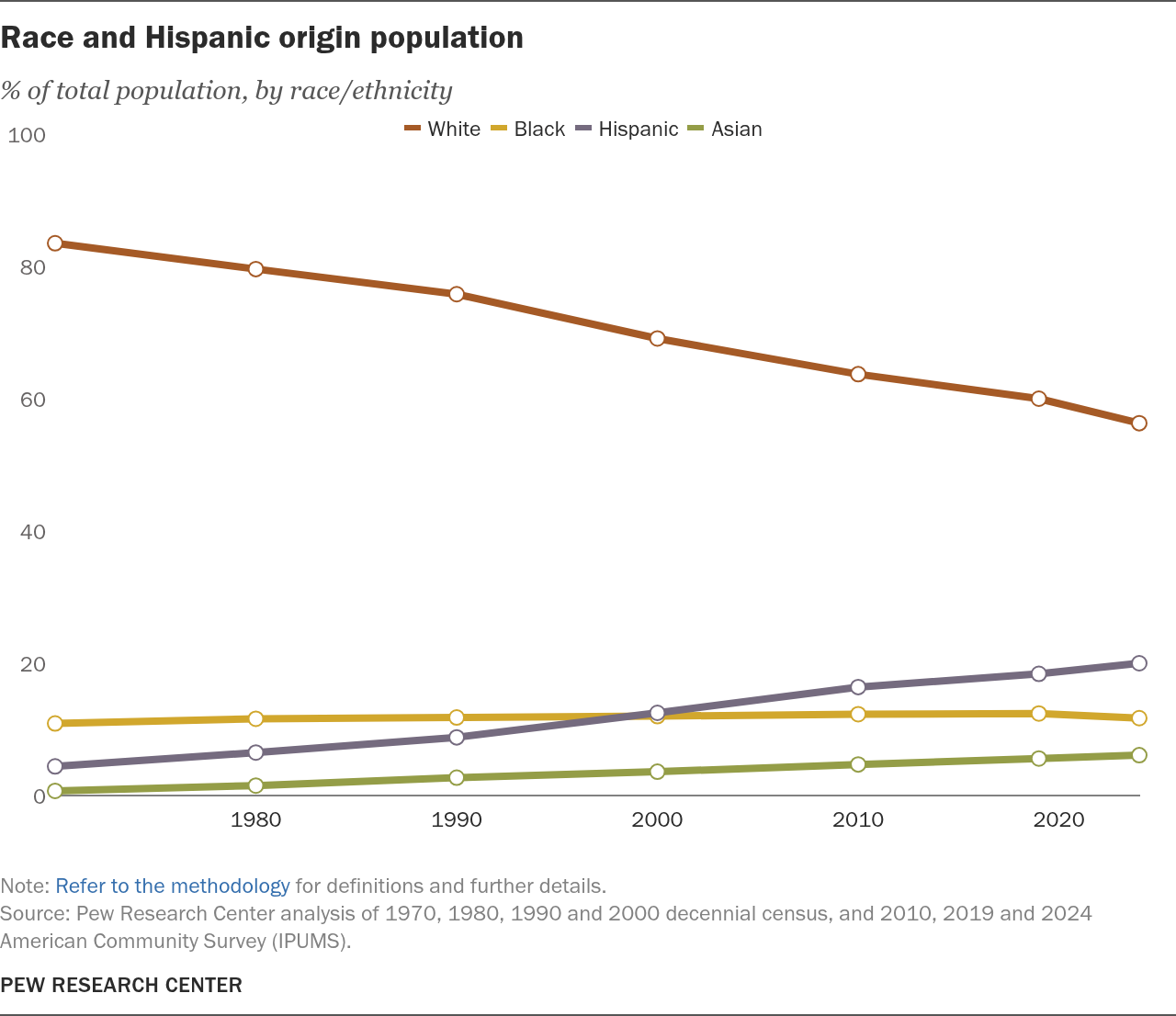 Note: Refer to the methodology for definitions and further details. Source: Pew Research Center analysis of 1970, 1980, 1990 and 2000 decennial census, and 2010, 2019 and 2024 American Community Survey (IPUMS).PEW RESEARCH CENTER
Note: Refer to the methodology for definitions and further details. Source: Pew Research Center analysis of 1970, 1980, 1990 and 2000 decennial census, and 2010, 2019 and 2024 American Community Survey (IPUMS).PEW RESEARCH CENTER
Share this chart
Race and Hispanic origin population% of total population, by race/ethnicity
| Year | White | Black | Hispanic | Asian |
|---|---|---|---|---|
| 1970 | 83.5% | 10.9% | 4.4% | 0.7% |
| 1980 | 79.6% | 11.6% | 6.5% | 1.5% |
| 1990 | 75.8% | 11.8% | 8.8% | 2.7% |
| 2000 | 69.1% | 12.0% | 12.5% | 3.6% |
| 2010 | 63.7% | 12.3% | 16.4% | 4.7% |
| 2019 | 60.0% | 12.4% | 18.4% | 5.6% |
| 2024 | 56.3% | 11.7% | 20.0% | 6.1% |
Download data as .csvNote: Refer to the methodology for definitions and further details. Source: Pew Research Center analysis of 1970, 1980, 1990 and 2000 decennial census, and 2010, 2019 and 2024 American Community Survey (IPUMS).PEW RESEARCH CENTER
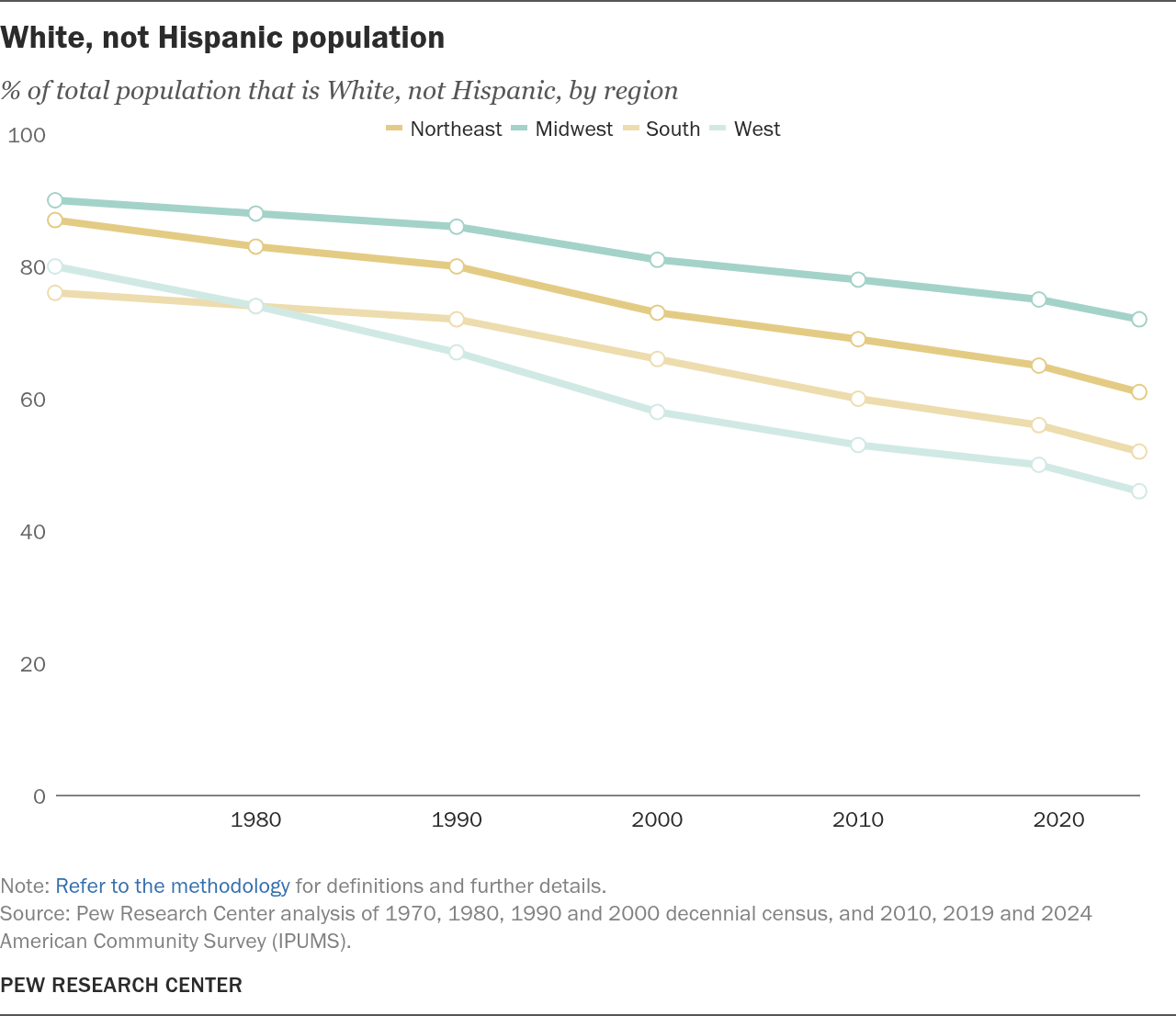 Note: Refer to the methodology for definitions and further details. Source: Pew Research Center analysis of 1970, 1980, 1990 and 2000 decennial census, and 2010, 2019 and 2024 American Community Survey (IPUMS).PEW RESEARCH CENTER
Share this chart
White, not Hispanic population% of total population that is White, not Hispanic, by region
| Year | Northeast | Midwest | South | West |
|---|---|---|---|---|
| 1970 | 87% | 90% | 76% | 80% |
| 1980 | 83% | 88% | 74% | 74% |
| 1990 | 80% | 86% | 72% | 67% |
| 2000 | 73% | 81% | 66% | 58% |
| 2010 | 69% | 78% | 60% | 53% |
| 2019 | 65% | 75% | 56% | 50% |
| 2024 | 61% | 72% | 52% | 46% |
Download data as .csvNote: Refer to the methodology for definitions and further details. Source: Pew Research Center analysis of 1970, 1980, 1990 and 2000 decennial census, and 2010, 2019 and 2024 American Community Survey (IPUMS).PEW RESEARCH CENTER
Зростання частки іммігрантів
Частка народжених за кордоном у США зросла більш ніж утричі з 1970 року – з 4,7% (рекордно низький показник) до 14,8% у 2024 році. Частка іммігрантів найвища серед американців азійського та латиноамериканського походження, а також серед тих, хто проживає на Заході та Північному Сході.
Immigrant population% of total population that is foreign born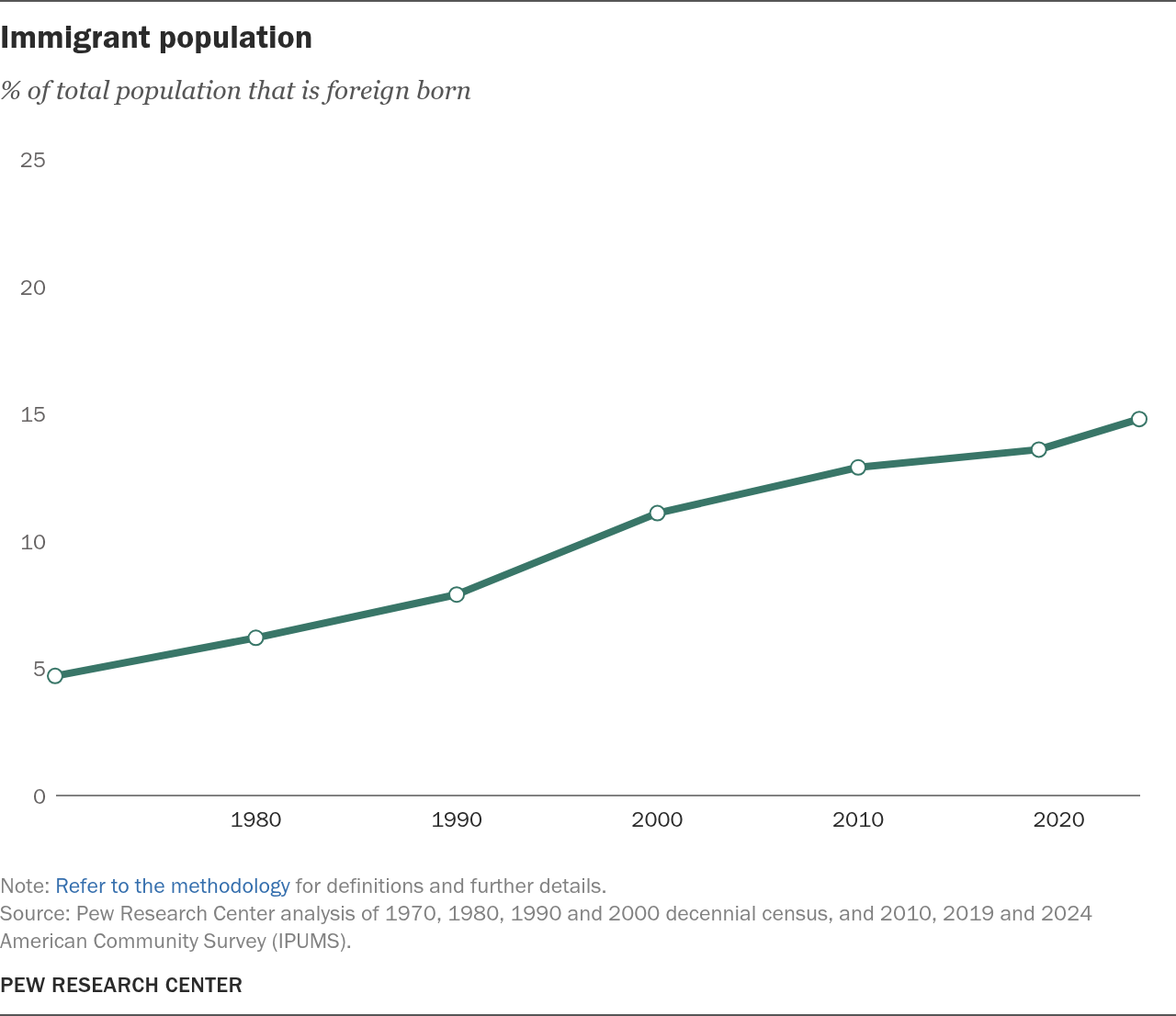 Note: Refer to the methodology for definitions and further details. Source: Pew Research Center analysis of 1970, 1980, 1990 and 2000 decennial census, and 2010, 2019 and 2024 American Community Survey (IPUMS).PEW RESEARCH CENTER
Note: Refer to the methodology for definitions and further details. Source: Pew Research Center analysis of 1970, 1980, 1990 and 2000 decennial census, and 2010, 2019 and 2024 American Community Survey (IPUMS).PEW RESEARCH CENTER
Share this chart
Immigrant population% of total population that is foreign born
| Year | All |
|---|---|
| 1970 | 4.7% |
| 1980 | 6.2% |
| 1990 | 7.9% |
| 2000 | 11.1% |
| 2010 | 12.9% |
| 2019 | 13.6% |
| 2024 | 14.8% |
Download data as .csvNote: Refer to the methodology for definitions and further details. Source: Pew Research Center analysis of 1970, 1980, 1990 and 2000 decennial census, and 2010, 2019 and 2024 American Community Survey (IPUMS).PEW RESEARCH CENTER
Immigrant population% of total population that is foreign born, by race/ethnicity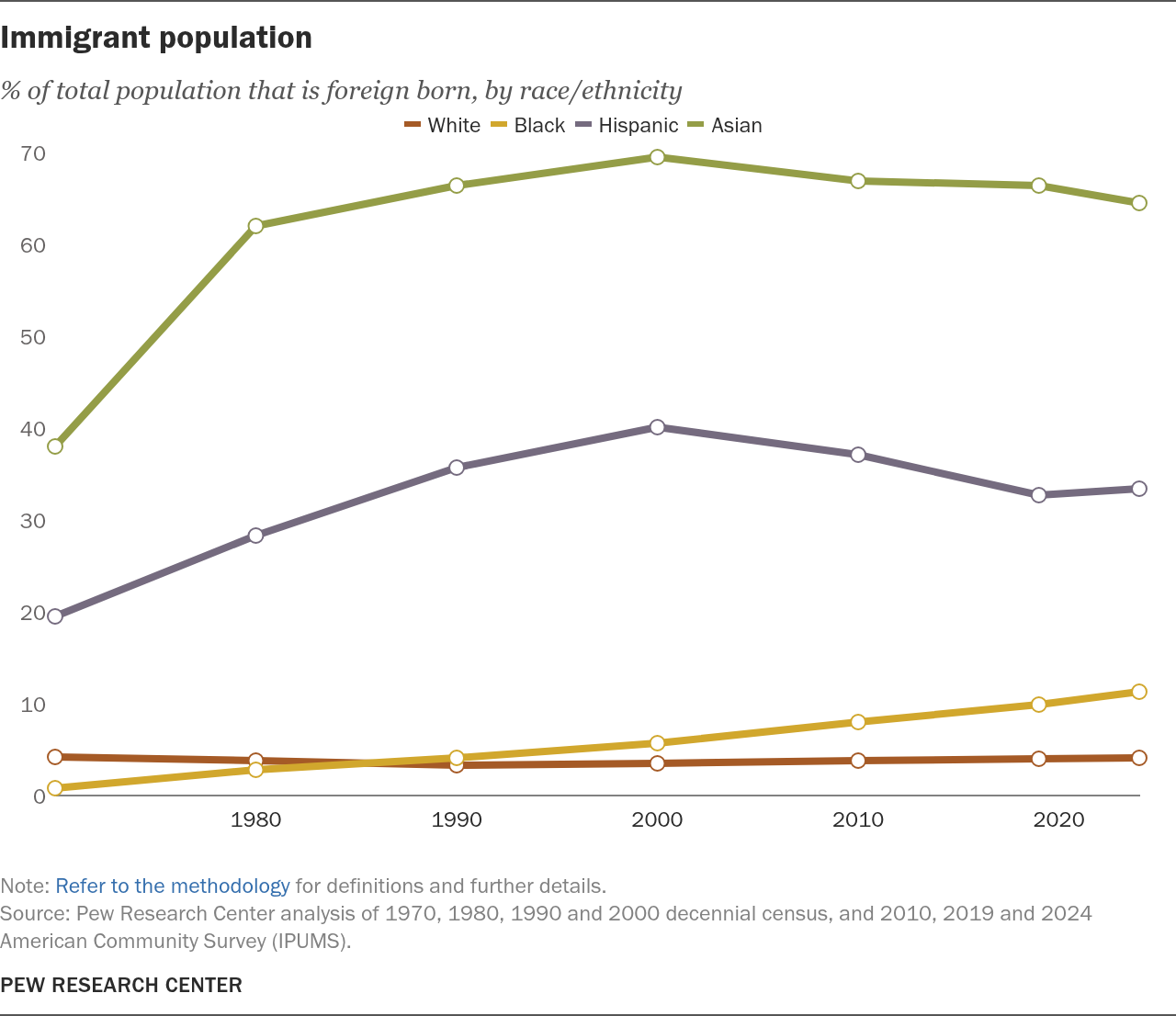 Note: Refer to the methodology for definitions and further details. Source: Pew Research Center analysis of 1970, 1980, 1990 and 2000 decennial census, and 2010, 2019 and 2024 American Community Survey (IPUMS).PEW RESEARCH CENTER
Note: Refer to the methodology for definitions and further details. Source: Pew Research Center analysis of 1970, 1980, 1990 and 2000 decennial census, and 2010, 2019 and 2024 American Community Survey (IPUMS).PEW RESEARCH CENTER
Share this chart
Immigrant population% of total population that is foreign born, by race/ethnicity
| Year | White | Black | Hispanic | Asian |
|---|---|---|---|---|
| 1970 | 4.2% | 0.8% | 19.5% | 38.0% |
| 1980 | 3.8% | 2.8% | 28.3% | 62.0% |
| 1990 | 3.3% | 4.1% | 35.7% | 66.4% |
| 2000 | 3.5% | 5.7% | 40.1% | 69.5% |
| 2010 | 3.8% | 8.0% | 37.1% | 66.9% |
| 2019 | 4.0% | 9.9% | 32.7% | 66.4% |
| 2024 | 4.1% | 11.3% | 33.4% | 64.5% |
Download data as .csvNote: Refer to the methodology for definitions and further details. Source: Pew Research Center analysis of 1970, 1980, 1990 and 2000 decennial census, and 2010, 2019 and 2024 American Community Survey (IPUMS).PEW RESEARCH CENTER
Immigrant population% of total population that is foreign born, by region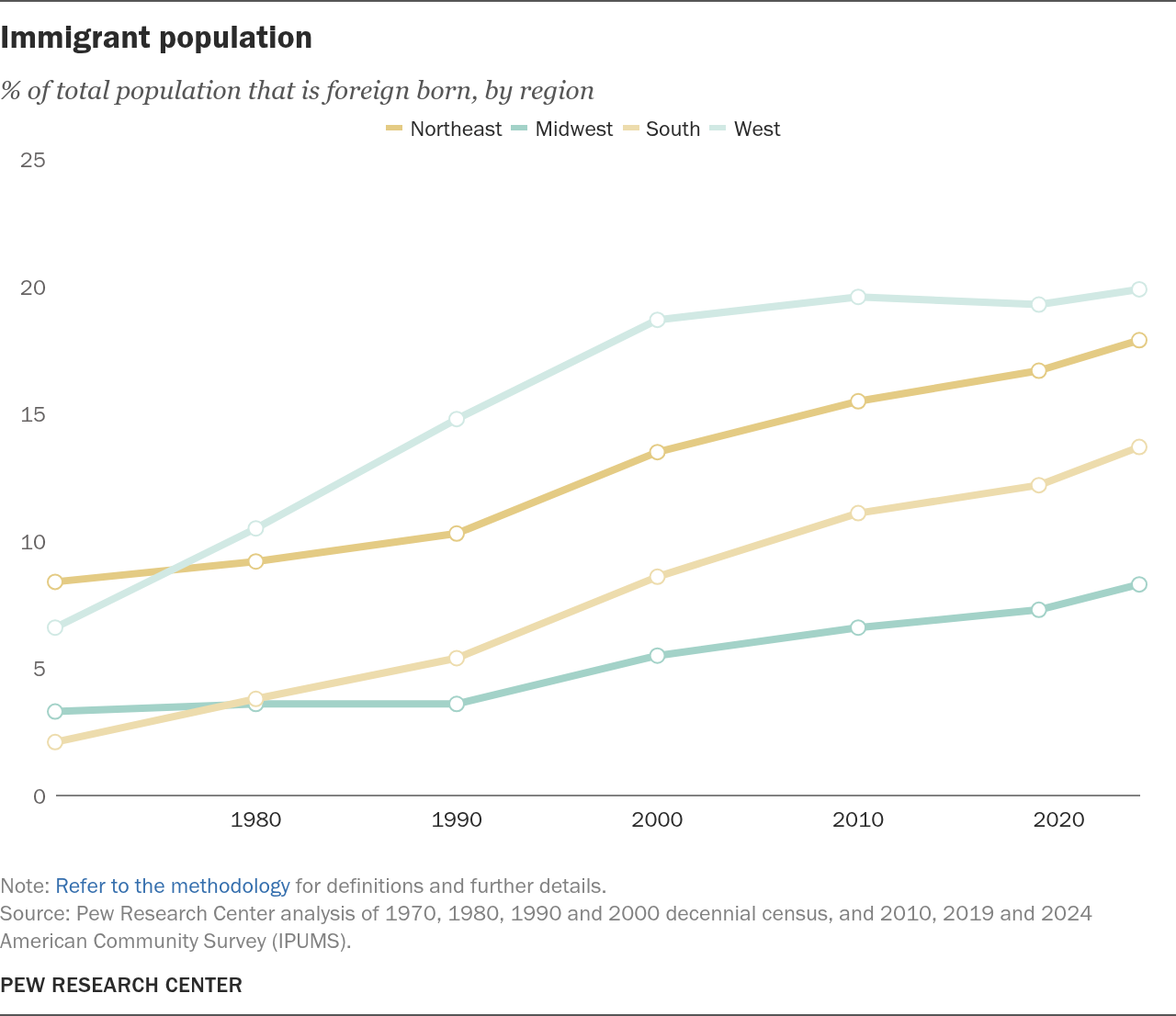 Note: Refer to the methodology for definitions and further details. Source: Pew Research Center analysis of 1970, 1980, 1990 and 2000 decennial census, and 2010, 2019 and 2024 American Community Survey (IPUMS).PEW RESEARCH CENTER
Note: Refer to the methodology for definitions and further details. Source: Pew Research Center analysis of 1970, 1980, 1990 and 2000 decennial census, and 2010, 2019 and 2024 American Community Survey (IPUMS).PEW RESEARCH CENTER
Share this chart
Immigrant population% of total population that is foreign born, by region
| Year | Northeast | Midwest | South | West |
|---|---|---|---|---|
| 1970 | 8.4% | 3.3% | 2.1% | 6.6% |
| 1980 | 9.2% | 3.6% | 3.8% | 10.5% |
| 1990 | 10.3% | 3.6% | 5.4% | 14.8% |
| 2000 | 13.5% | 5.5% | 8.6% | 18.7% |
| 2010 | 15.5% | 6.6% | 11.1% | 19.6% |
| 2019 | 16.7% | 7.3% | 12.2% | 19.3% |
| 2024 | 17.9% | 8.3% | 13.7% | 19.9% |
Download data as .csvNote: Refer to the methodology for definitions and further details. Source: Pew Research Center analysis of 1970, 1980, 1990 and 2000 decennial census, and 2010, 2019 and 2024 American Community Survey (IPUMS).PEW RESEARCH CENTER
Підйом “Сонячного поясу”
У 1970 році менше половини населення США проживало на Півдні (31%) та Заході (17%), тоді як сьогодні більше шести з десяти американців мешкають у цих штатах.
Population% of total population, by region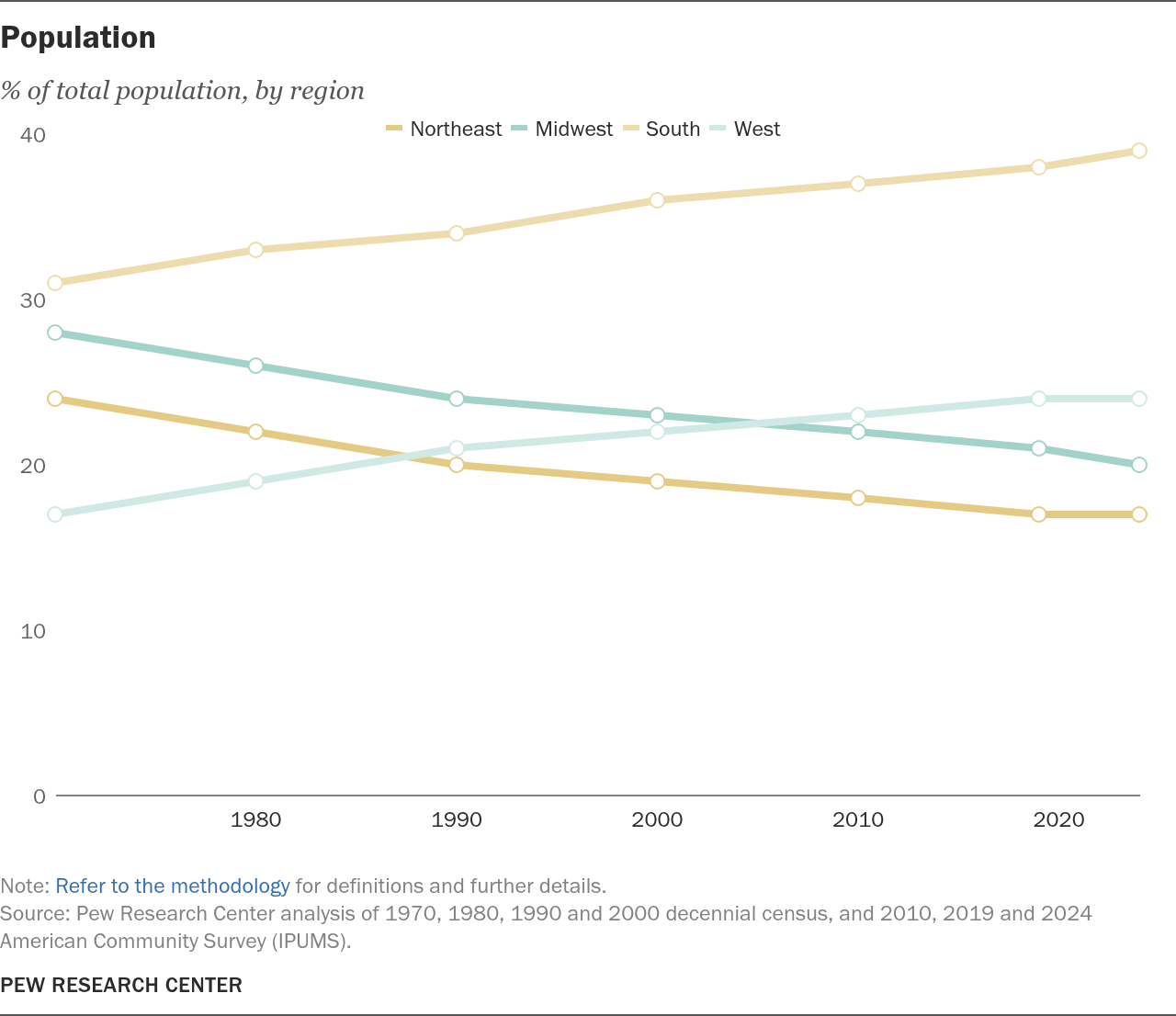 Note: Refer to the methodology for definitions and further details. Source: Pew Research Center analysis of 1970, 1980, 1990 and 2000 decennial census, and 2010, 2019 and 2024 American Community Survey (IPUMS).PEW RESEARCH CENTER
Note: Refer to the methodology for definitions and further details. Source: Pew Research Center analysis of 1970, 1980, 1990 and 2000 decennial census, and 2010, 2019 and 2024 American Community Survey (IPUMS).PEW RESEARCH CENTER
Share this chart
Population% of total population, by region
| Year | Northeast | Midwest | South | West |
|---|---|---|---|---|
| 1970 | 24% | 28% | 31% | 17% |
| 1980 | 22% | 26% | 33% | 19% |
| 1990 | 20% | 24% | 34% | 21% |
| 2000 | 19% | 23% | 36% | 22% |
| 2010 | 18% | 22% | 37% | 23% |
| 2019 | 17% | 21% | 38% | 24% |
| 2024 | 17% | 20% | 39% | 24% |
Download data as .csvNote: Refer to the methodology for definitions and further details. Source: Pew Research Center analysis of 1970, 1980, 1990 and 2000 decennial census, and 2010, 2019 and 2024 American Community Survey (IPUMS).PEW RESEARCH CENTER

Робота
Працівники в комп’ютерному залі філадельфійського офісу IRS у 1965 році. Трейдери аналізують комп’ютерні дані у 2017 році. (Marion Trikosko/PhotoQuest, Tetra Images через Getty Images)
Трансформація США з індустріальної економіки на економіку послуг та інформації супроводжувалася значними змінами на ринку праці. Зарахування до вищих навчальних закладів значно розширилося, що призвело до завершення коледжу більшою кількістю дорослих. Робоча сила США зросла, значною мірою завдяки збільшенню зайнятості жінок поза домом. Загалом, доходи типового працівника зросли.
Здобутки у вищій освіті
Частка дорослих, які закінчили принаймні бакалаврат, зросла більш ніж утричі з 1970 року – з 11% до 37%. Збільшення було більшим для жінок, ніж для чоловіків.
Education% of adults ages 25 and older who completed at least a bachelor’s degree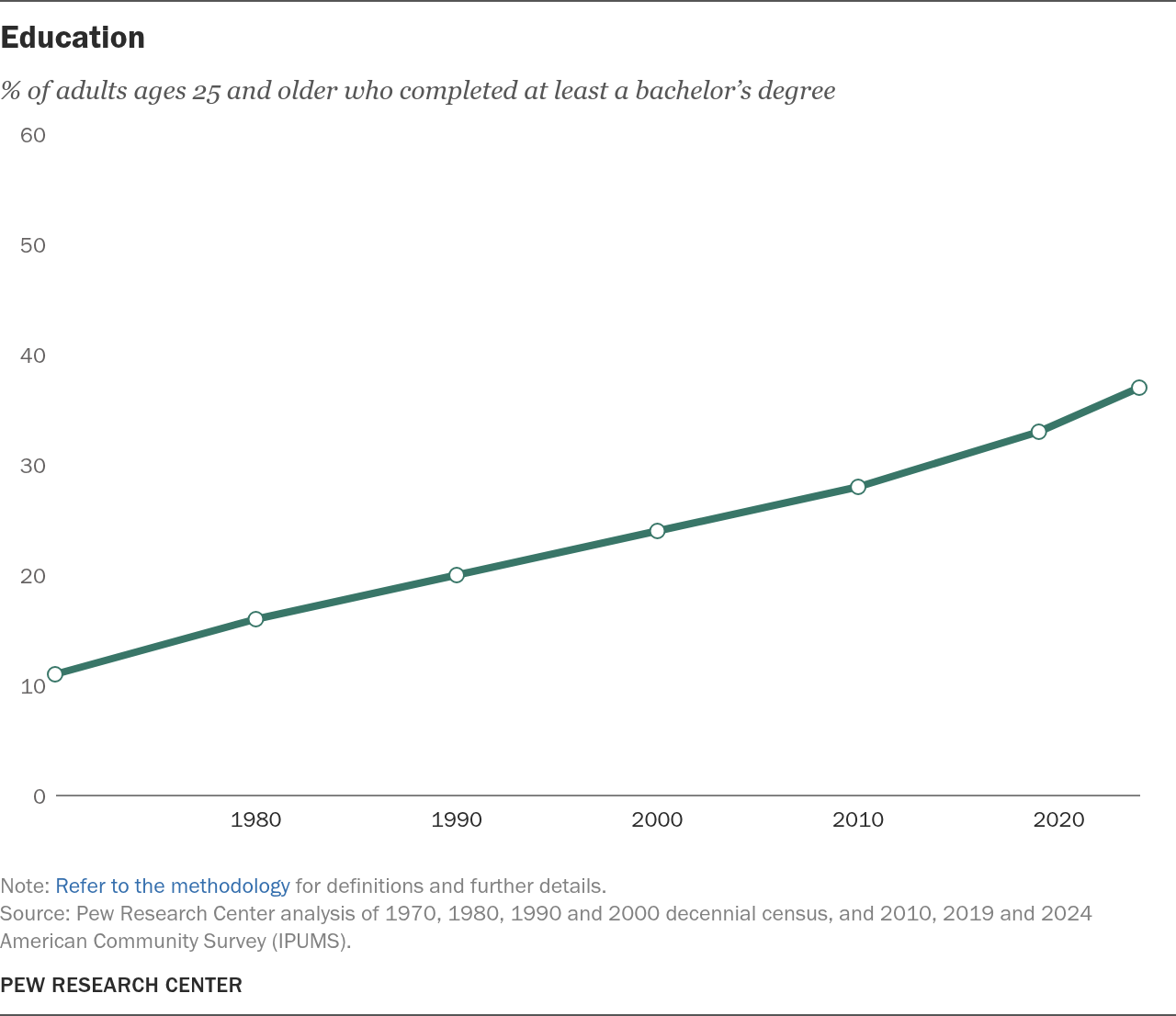 Note: Refer to the methodology for definitions and further details. Source: Pew Research Center analysis of 1970, 1980, 1990 and 2000 decennial census, and 2010, 2019 and 2024 American Community Survey (IPUMS).PEW RESEARCH CENTER
Note: Refer to the methodology for definitions and further details. Source: Pew Research Center analysis of 1970, 1980, 1990 and 2000 decennial census, and 2010, 2019 and 2024 American Community Survey (IPUMS).PEW RESEARCH CENTER
Share this chart
Education% of adults ages 25 and older who completed at least a bachelor’s degree
| Year | All |
|---|---|
| 1970 | 11% |
| 1980 | 16% |
| 1990 | 20% |
| 2000 | 24% |
| 2010 | 28% |
| 2019 | 33% |
| 2024 | 37% |
Download data as .csvNote: Refer to the methodology for definitions and further details. Source: Pew Research Center analysis of 1970, 1980, 1990 and 2000 decennial census, and 2010, 2019 and 2024 American Community Survey (IPUMS).PEW RESEARCH CENTER
Education% of adults ages 25 and older who completed at least a bachelor’s degree, by gender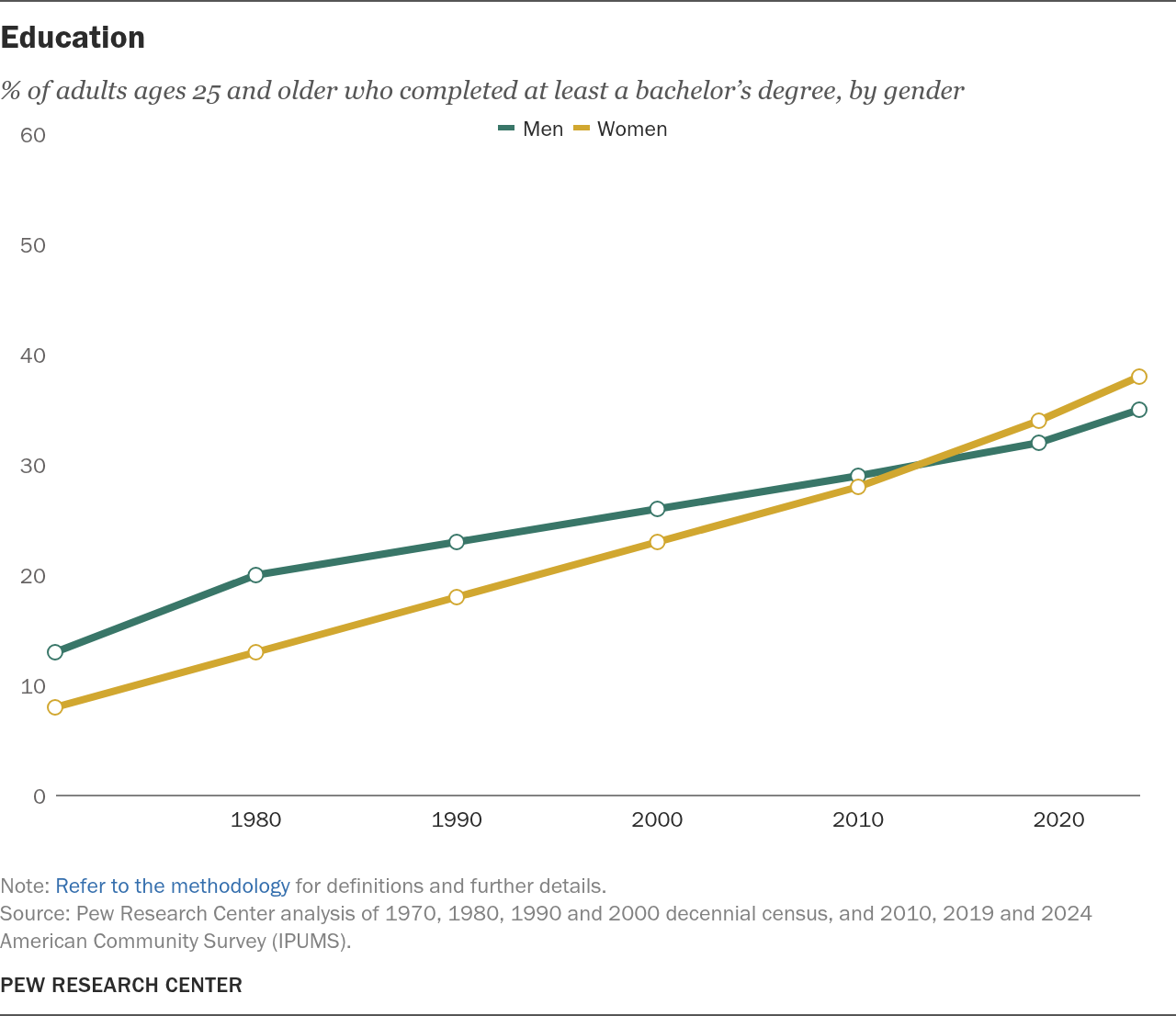 Note: Refer to the methodology for definitions and further details. Source: Pew Research Center analysis of 1970, 1980, 1990 and 2000 decennial census, and 2010, 2019 and 2024 American Community Survey (IPUMS).PEW RESEARCH CENTER
Note: Refer to the methodology for definitions and further details. Source: Pew Research Center analysis of 1970, 1980, 1990 and 2000 decennial census, and 2010, 2019 and 2024 American Community Survey (IPUMS).PEW RESEARCH CENTER
Share this chart
Education% of adults ages 25 and older who completed at least a bachelor’s degree, by gender
| Year | Men | Women |
|---|---|---|
| 1970 | 13% | 8% |
| 1980 | 20% | 13% |
| 1990 | 23% | 18% |
| 2000 | 26% | 23% |
| 2010 | 29% | 28% |
| 2019 | 32% | 34% |
| 2024 | 35% | 38% |
Download data as .csvNote: Refer to the methodology for definitions and further details. Source: Pew Research Center analysis of 1970, 1980, 1990 and 2000 decennial census, and 2010, 2019 and 2024 American Community Survey (IPUMS).PEW RESEARCH CENTER
Education% of adults ages 25 and older who completed at least a bachelor’s degree, by race/ethnicity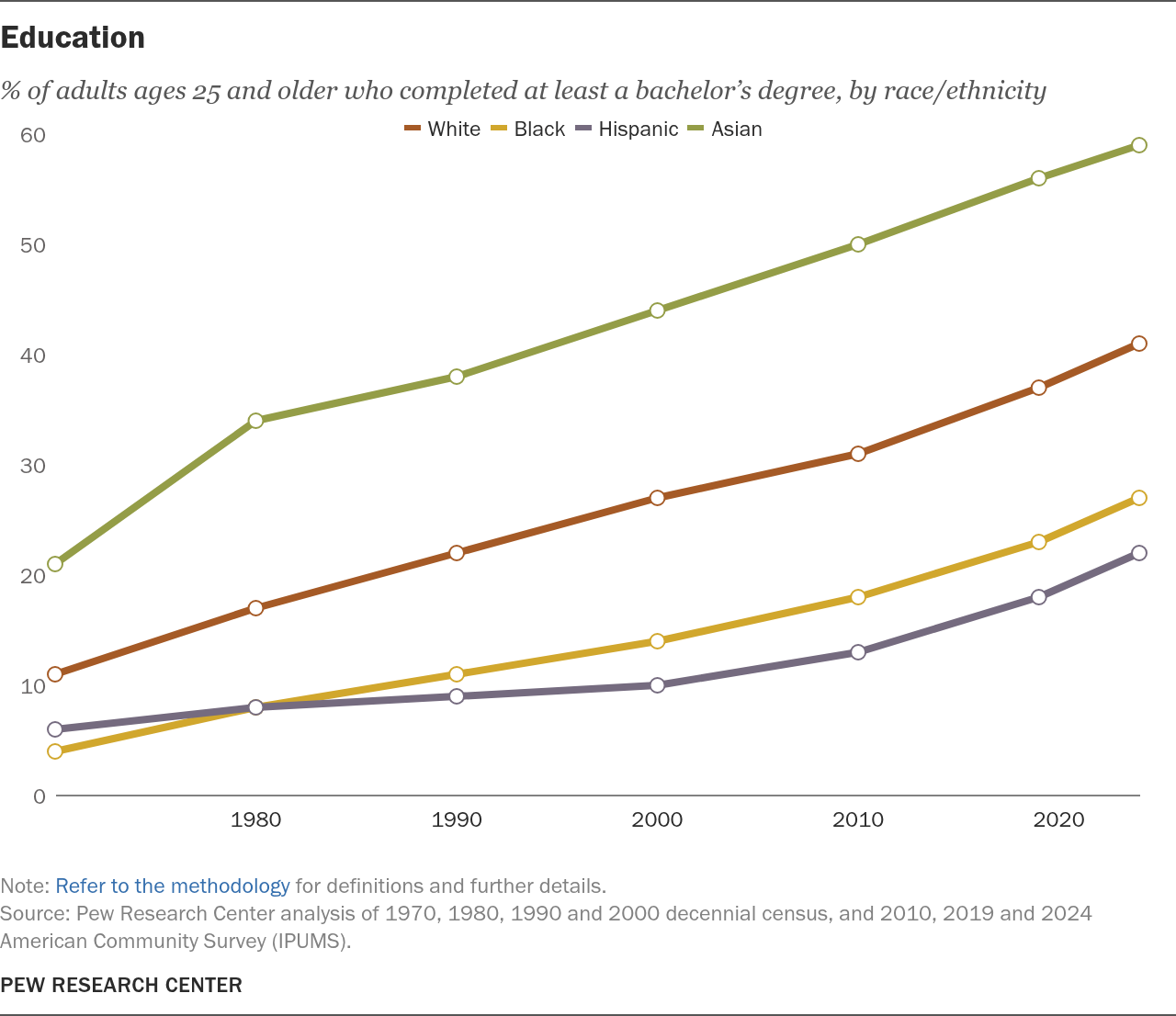 Note: Refer to the methodology for definitions and further details. Source: Pew Research Center analysis of 1970, 1980, 1990 and 2000 decennial census, and 2010, 2019 and 2024 American Community Survey (IPUMS).PEW RESEARCH CENTER
Note: Refer to the methodology for definitions and further details. Source: Pew Research Center analysis of 1970, 1980, 1990 and 2000 decennial census, and 2010, 2019 and 2024 American Community Survey (IPUMS).PEW RESEARCH CENTER
Share this chart
Education% of adults ages 25 and older who completed at least a bachelor’s degree, by race/ethnicity
| Year | White | Black | Hispanic | Asian |
|---|---|---|---|---|
| 1970 | 11% | 4% | 6% | 21% |
| 1980 | 17% | 8% | 8% | 34% |
| 1990 | 22% | 11% | 9% | 38% |
| 2000 | 27% | 14% | 10% | 44% |
| 2010 | 31% | 18% | 13% | 50% |
| 2019 | 37% | 23% | 18% | 56% |
| 2024 | 41% | 27% | 22% | 59% |
Download data as .csvNote: Refer to the methodology for definitions and further details. Source: Pew Research Center analysis of 1970, 1980, 1990 and 2000 decennial census, and 2010, 2019 and 2024 American Community Survey (IPUMS).PEW RESEARCH CENTER
Жінки змінюють ринок праці
Частка населення, яка працює або шукає роботу, дещо зросла з 1970 року. Рівень участі в робочій силі зріс серед жінок, але знизився серед чоловіків.
Labor force participation% of civilians ages 16 and older working or looking for work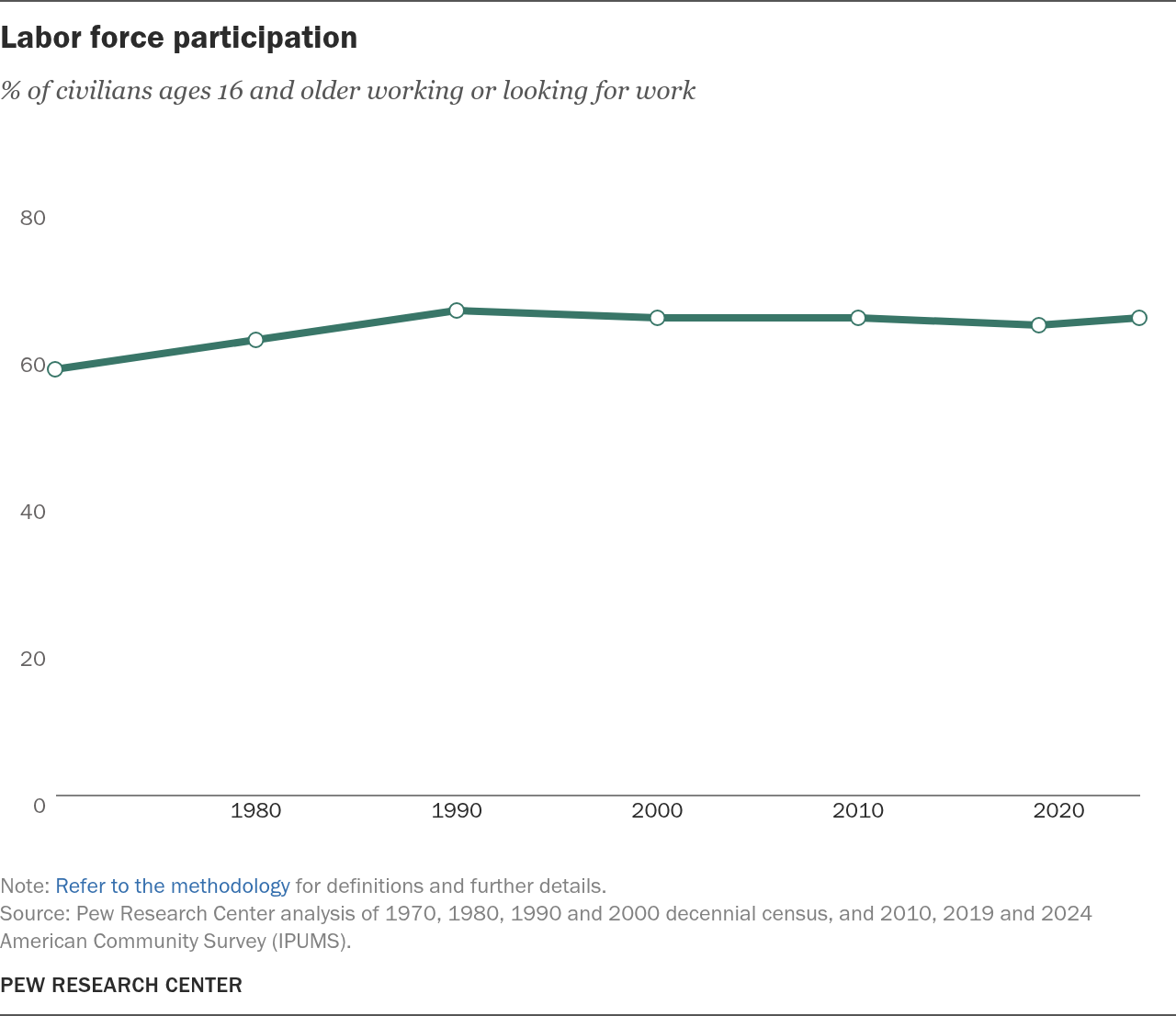 Note: Refer to the methodology for definitions and further details. Source: Pew Research Center analysis of 1970, 1980, 1990 and 2000 decennial census, and 2010, 2019 and 2024 American Community Survey (IPUMS).PEW RESEARCH CENTER
Note: Refer to the methodology for definitions and further details. Source: Pew Research Center analysis of 1970, 1980, 1990 and 2000 decennial census, and 2010, 2019 and 2024 American Community Survey (IPUMS).PEW RESEARCH CENTER
Share this chart
Labor force participation% of civilians ages 16 and older working or looking for work
| Year | All |
|---|---|
| 1970 | 58% |
| 1980 | 62% |
| 1990 | 66% |
| 2000 | 65% |
| 2010 | 65% |
| 2019 | 64% |
| 2024 | 65% |
Download data as .csvNote: Refer to the methodology for definitions and further details. Source: Pew Research Center analysis of 1970, 1980, 1990 and 2000 decennial census, and 2010, 2019 and 2024 American Community Survey (IPUMS).PEW RESEARCH CENTER
Labor force participation% of civilians ages 25 and older working or looking for work, by education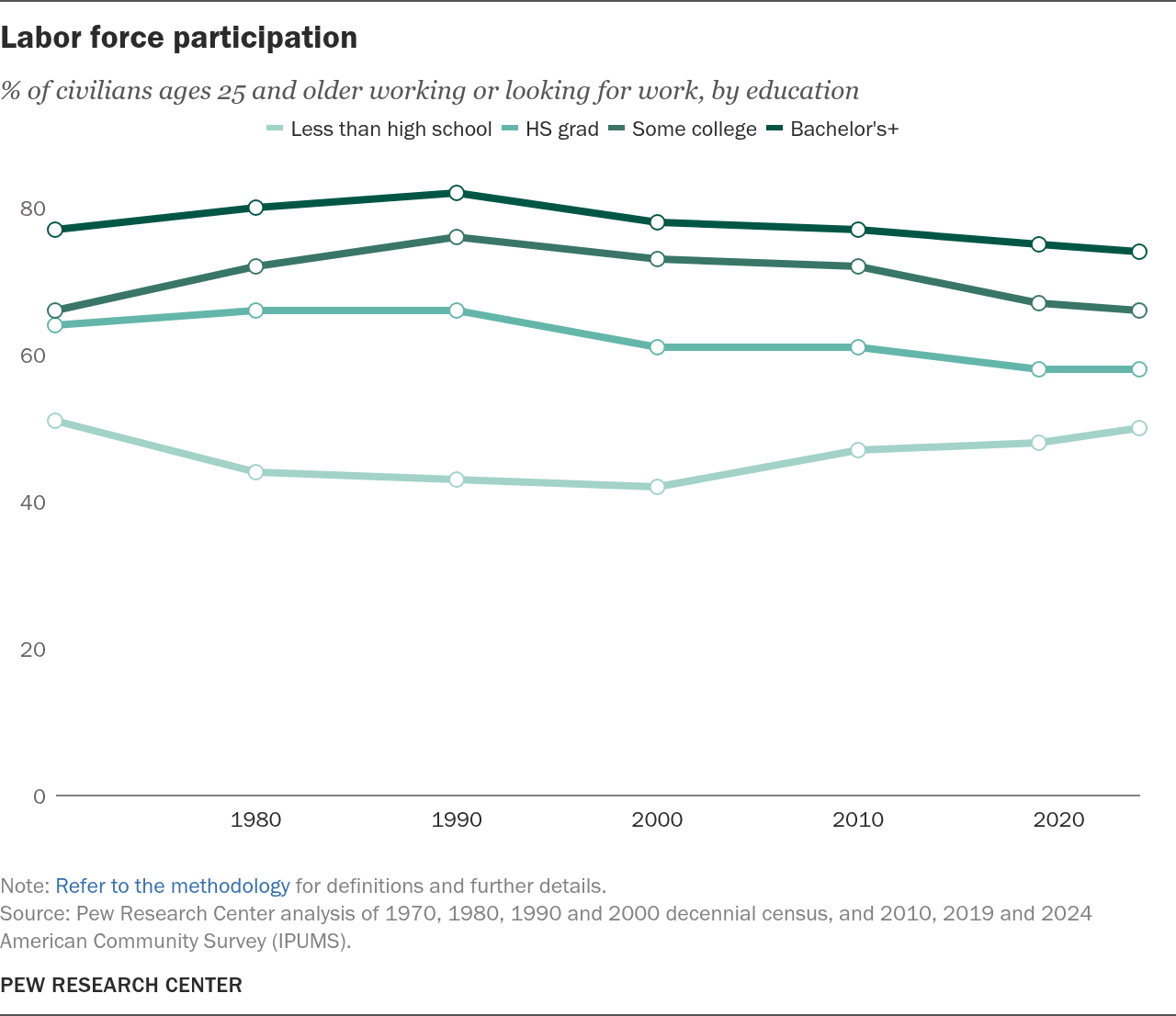 Note: Refer to the methodology for definitions and further details. Source: Pew Research Center analysis of 1970, 1980, 1990 and 2000 decennial census, and 2010, 2019 and 2024 American Community Survey (IPUMS).PEW RESEARCH CENTER
Note: Refer to the methodology for definitions and further details. Source: Pew Research Center analysis of 1970, 1980, 1990 and 2000 decennial census, and 2010, 2019 and 2024 American Community Survey (IPUMS).PEW RESEARCH CENTER
Share this chart
Labor force participation% of civilians ages 25 and older working or looking for work, by education
| Year | Less than high school | HS grad | Some college | Bachelor’s+ |
|---|---|---|---|---|
| 1970 | 51% | 64% | 66% | 77% |
| 1980 | 44% | 66% | 72% | 80% |
| 1990 | 43% | 66% | 76% | 82% |
| 2000 | 42% | 61% | 73% | 78% |
| 2010 | 47% | 61% | 72% | 77% |
| 2019 | 48% | 58% | 67% | 75% |
| 2024 | 50% | 58% | 66% | 74% |
Download data as .csvNote: Refer to the methodology for definitions and further details. Source: Pew Research Center analysis of 1970, 1980, 1990 and 2000 decennial census, and 2010, 2019 and 2024 American Community Survey (IPUMS).PEW RESEARCH CENTER
Labor force participation% of civilians ages 16 and older working or looking for work, by gender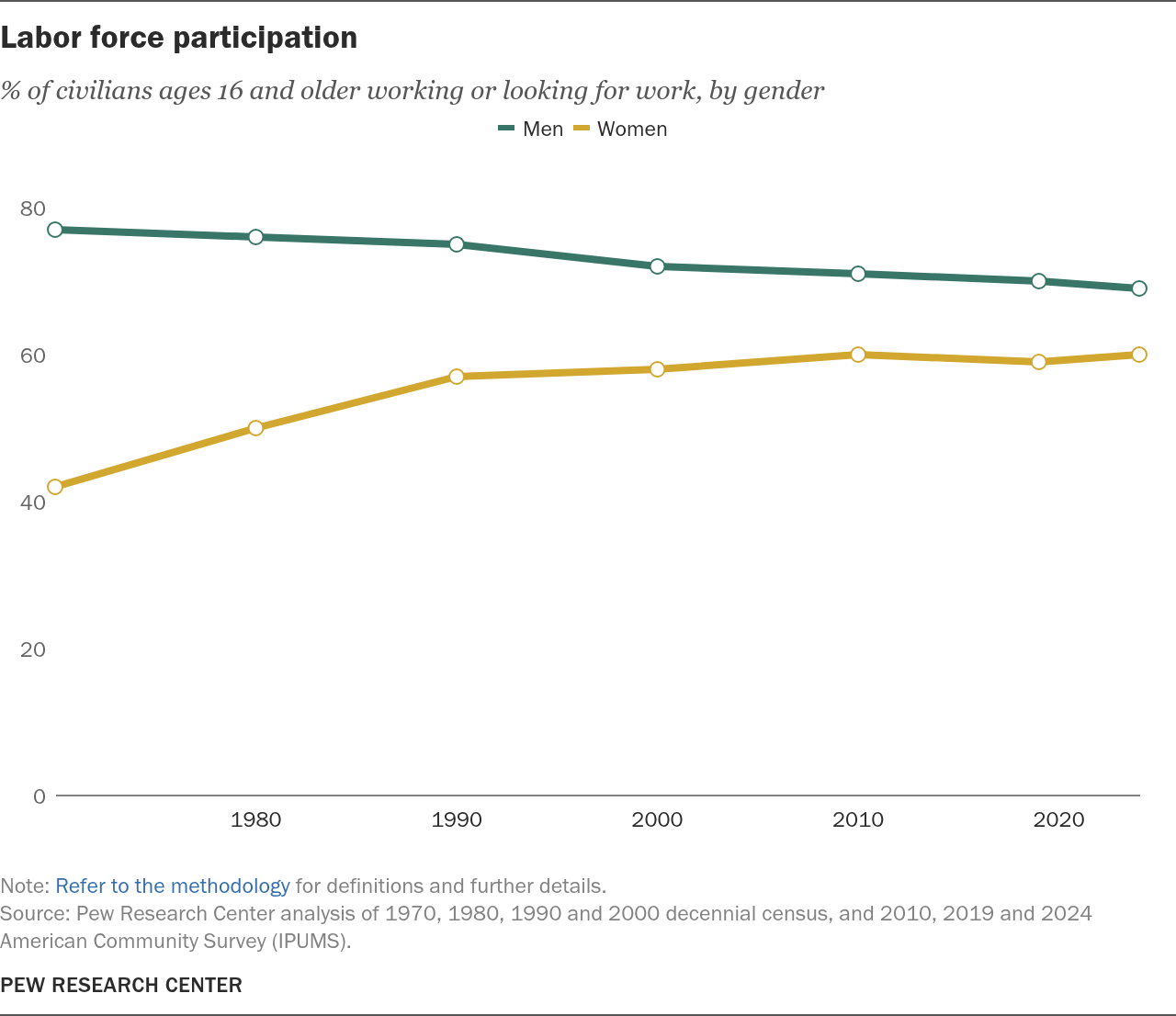 Note: Refer to the methodology for definitions and further details. Source: Pew Research Center analysis of 1970, 1980, 1990 and 2000 decennial census, and 2010, 2019 and 2024 American Community Survey (IPUMS).PEW RESEARCH CENTER
Note: Refer to the methodology for definitions and further details. Source: Pew Research Center analysis of 1970, 1980, 1990 and 2000 decennial census, and 2010, 2019 and 2024 American Community Survey (IPUMS).PEW RESEARCH CENTER
Share this chart
Labor force participation% of civilians ages 16 and older working or looking for work, by gender
| Year | Men | Women |
|---|---|---|
| 1970 | 77% | 42% |
| 1980 | 76% | 50% |
| 1990 | 75% | 57% |
| 2000 | 72% | 58% |
| 2010 | 71% | 60% |
| 2019 | 70% | 59% |
| 2024 | 69% | 60% |
Download data as .csvNote: Refer to the methodology for definitions and further details. Source: Pew Research Center analysis of 1970, 1980, 1990 and 2000 decennial census, and 2010, 2019 and 2024 American Community Survey (IPUMS).PEW RESEARCH CENTER
Labor force participation% of civilians ages 16 and older working or looking for work, by race/ethnicity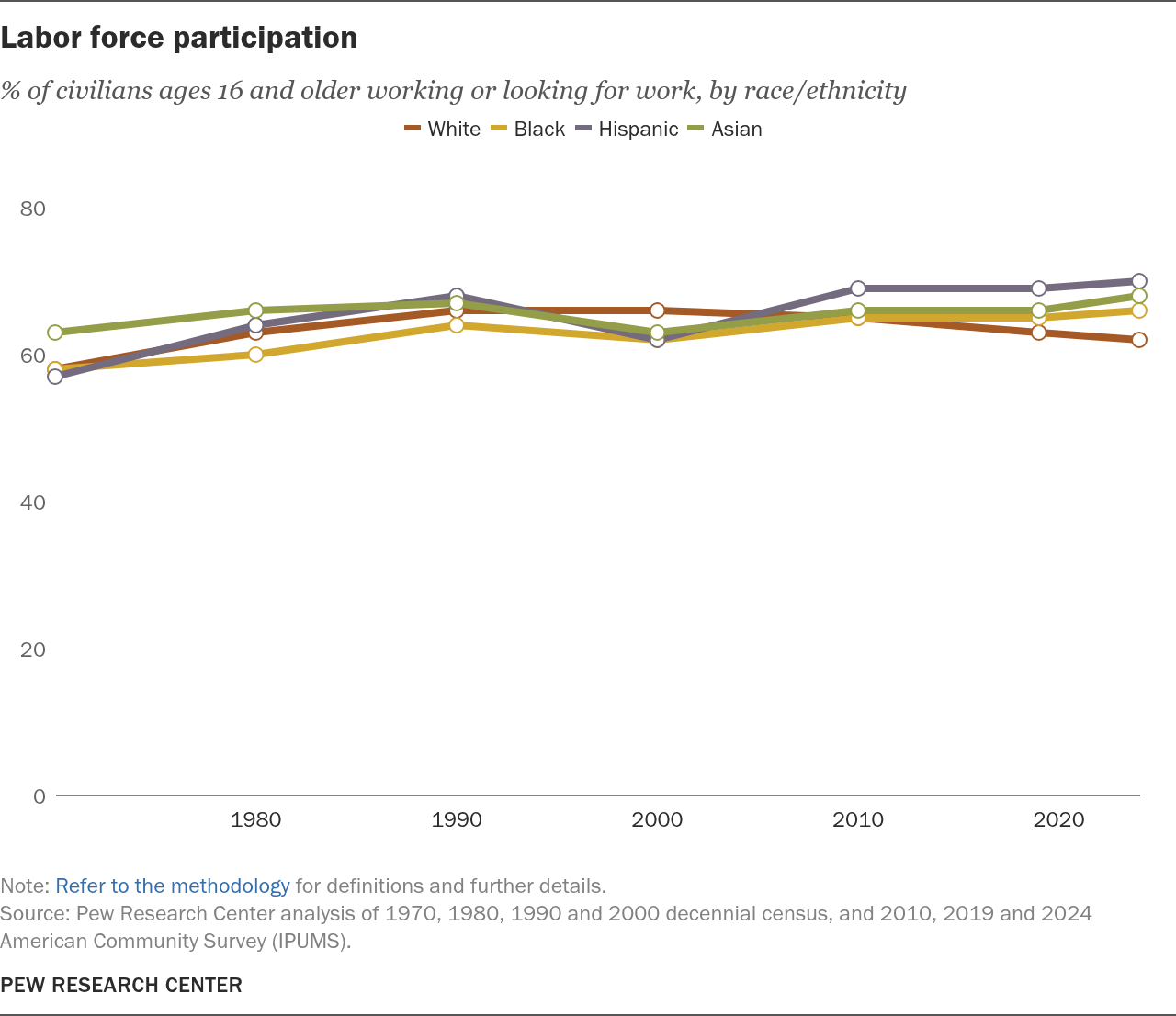 Note: Refer to the methodology for definitions and further details. Source: Pew Research Center analysis of 1970, 1980, 1990 and 2000 decennial census, and 2010, 2019 and 2024 American Community Survey (IPUMS).PEW RESEARCH CENTER
Note: Refer to the methodology for definitions and further details. Source: Pew Research Center analysis of 1970, 1980, 1990 and 2000 decennial census, and 2010, 2019 and 2024 American Community Survey (IPUMS).PEW RESEARCH CENTER
Share this chart
Labor force participation% of civilians ages 16 and older working or looking for work, by race/ethnicity
| Year | White | Black | Asian | Hispanic |
|---|---|---|---|---|
| 1970 | 58% | 58% | 63% | 57% |
| 1980 | 63% | 60% | 66% | 64% |
| 1990 | 66% | 64% | 67% | 68% |
| 2000 | 66% | 62% | 63% | 62% |
| 2010 | 65% | 65% | 66% | 69% |
| 2019 | 63% | 65% | 66% | 69% |
| 2024 | 62% | 66% | 68% | 70% |
Download data as .csvNote: Refer to the methodology for definitions and further details. Source: Pew Research Center analysis of 1970, 1980, 1990 and 2000 decennial census, and 2010, 2019 and 2024 American Community Survey (IPUMS).PEW RESEARCH CENTER
Розриви в заробітках зростають
Середній реальний річний заробіток працівників зріс з 1970 року. Але приріст є нерівномірним, переважно йдучи працівникам з вищою освітою, а не тим, хто має меншу освіту.
EarningsMedian annual earnings in 2023 dollars of workers ages 16 and older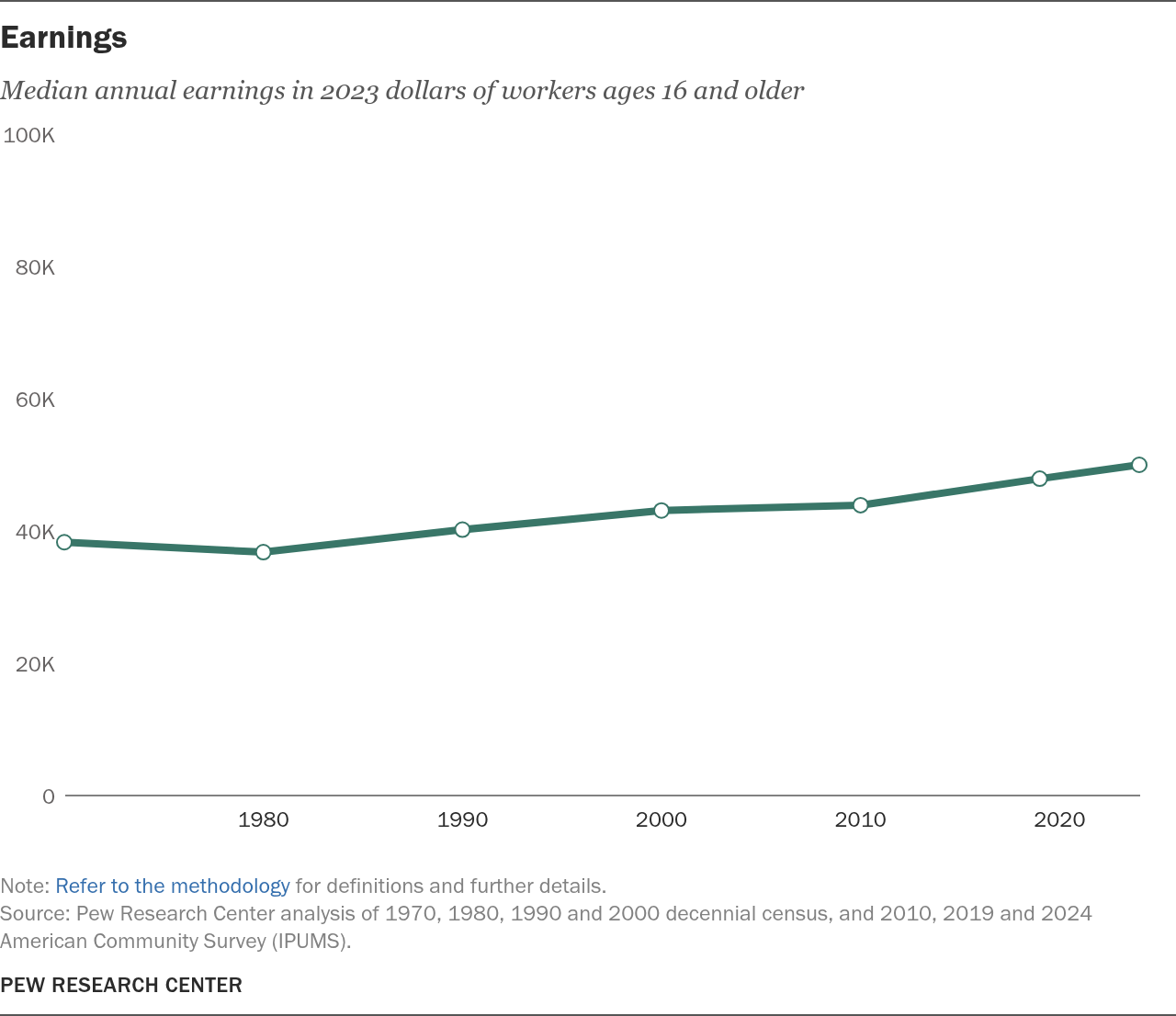 Note: Refer to the methodology for definitions and further details. Source: Pew Research Center analysis of 1970, 1980, 1990 and 2000 decennial census, and 2010, 2019 and 2024 American Community Survey (IPUMS).PEW RESEARCH CENTER
Note: Refer to the methodology for definitions and further details. Source: Pew Research Center analysis of 1970, 1980, 1990 and 2000 decennial census, and 2010, 2019 and 2024 American Community Survey (IPUMS).PEW RESEARCH CENTER
Share this chart
EarningsMedian annual earnings in 2023 dollars of workers ages 16 and older
| Year | All |
|---|---|
| 1970 | $38,300 |
| 1980 | $36,800 |
| 1990 | $40,200 |
| 2000 | $43,100 |
| 2010 | $43,900 |
| 2019 | $47,900 |
| 2024 | $50,000 |
Download data as .csvNote: Refer to the methodology for definitions and further details. Source: Pew Research Center analysis of 1970, 1980, 1990 and 2000 decennial census, and 2010, 2019 and 2024 American Community Survey (IPUMS).PEW RESEARCH CENTER
EarningsMedian annual earnings in 2023 dollars of workers ages 16 and older, by gender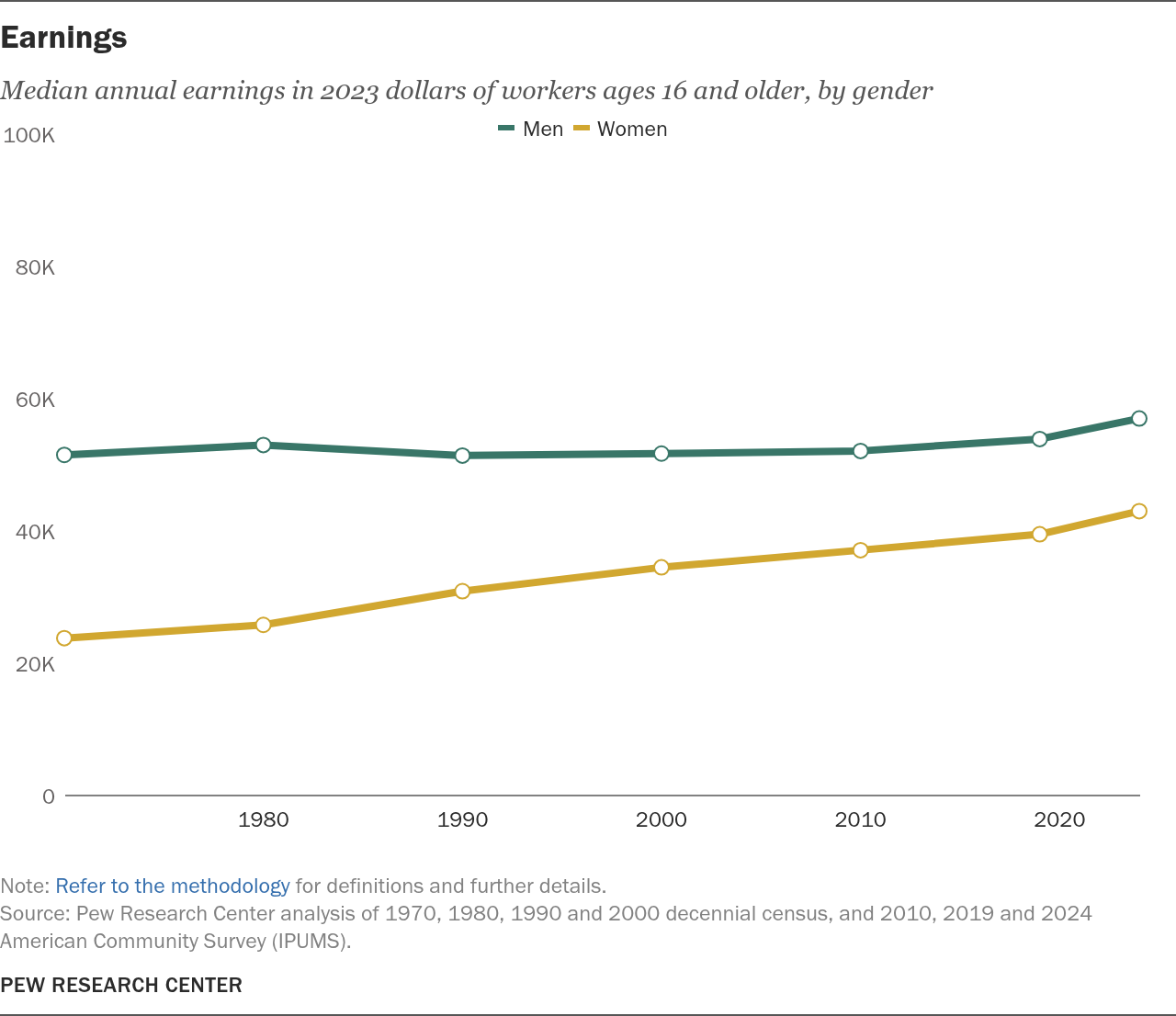 Note: Refer to the methodology for definitions and further details. Source: Pew Research Center analysis of 1970, 1980, 1990 and 2000 decennial census, and 2010, 2019 and 2024 American Community Survey (IPUMS).PEW RESEARCH CENTER
Note: Refer to the methodology for definitions and further details. Source: Pew Research Center analysis of 1970, 1980, 1990 and 2000 decennial census, and 2010, 2019 and 2024 American Community Survey (IPUMS).PEW RESEARCH CENTER
Share this chart
EarningsMedian annual earnings in 2023 dollars of workers ages 16 and older, by gender
| Year | Men | Women |
|---|---|---|
| 1970 | $51,500 | $23,800 |
| 1980 | $53,000 | $25,800 |
| 1990 | $51,400 | $30,900 |
| 2000 | $51,700 | $34,500 |
| 2010 | $52,100 | $37,100 |
| 2019 | $53,900 | $39,500 |
| 2024 | $57,000 | $43,000 |
Download data as .csvNote: Refer to the methodology for definitions and further details. Source: Pew Research Center analysis of 1970, 1980, 1990 and 2000 decennial census, and 2010, 2019 and 2024 American Community Survey (IPUMS).PEW RESEARCH CENTER
EarningsMedian annual earnings in 2023 dollars of workers ages 25 and older, by education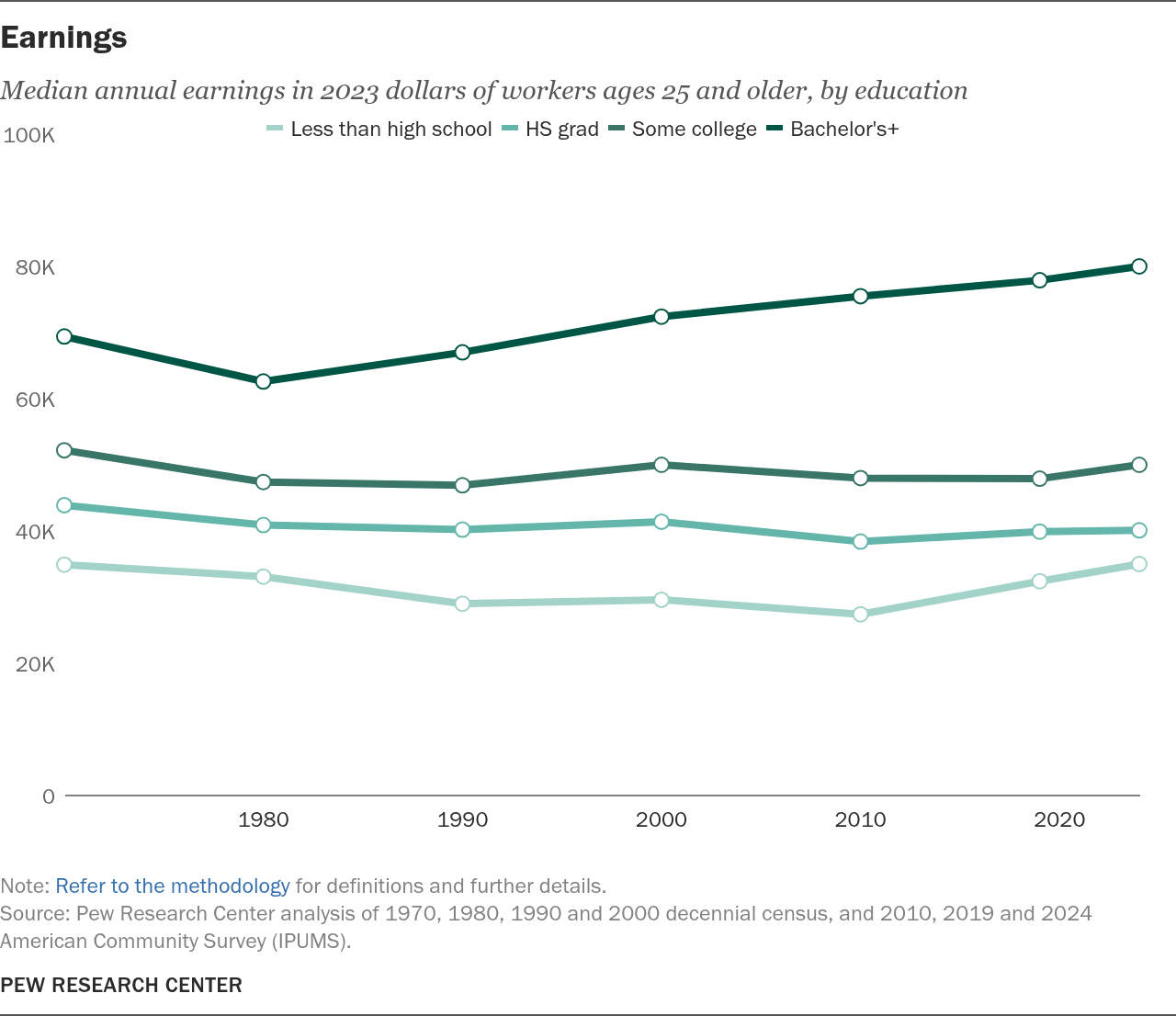 Note: Refer to the methodology for definitions and further details. Source: Pew Research Center analysis of 1970, 1980, 1990 and 2000 decennial census, and 2010, 2019 and 2024 American Community Survey (IPUMS).PEW RESEARCH CENTER
Note: Refer to the methodology for definitions and further details. Source: Pew Research Center analysis of 1970, 1980, 1990 and 2000 decennial census, and 2010, 2019 and 2024 American Community Survey (IPUMS).PEW RESEARCH CENTER
Share this chart
EarningsMedian annual earnings in 2023 dollars of workers ages 25 and older, by education
| Year | Less than high school | HS grad | Some college | Bachelor’s+ |
|---|---|---|---|---|
| 1970 | $34,900 | $43,900 | $52,200 | $69,400 |
| 1980 | $33,100 | $40,900 | $47,400 | $62,600 |
| 1990 | $29,000 | $40,200 | $46,900 | $67,000 |
| 2000 | $29,600 | $41,400 | $50,000 | $72,400 |
| 2010 | $27,400 | $38,400 | $48,000 | $75,500 |
| 2019 | $32,400 | $39,900 | $47,900 | $77,900 |
| 2024 | $35,000 | $40,100 | $50,000 | $80,000 |
Download data as .csvNote: Refer to the methodology for definitions and further details. Source: Pew Research Center analysis of 1970, 1980, 1990 and 2000 decennial census, and 2010, 2019 and 2024 American Community Survey (IPUMS).PEW RESEARCH CENTER

Сім’я
Сім’ї святкують двохсотріччя США у Бойлі, Колорадо. Сім’я ділить трапезу у своєму багатопоколіннєвому домі у Фейрфаксі, Вірджинія, у 2022 році. (Tony Korody/Sygma, Astrid Riecken/The Washington Post через Getty Images)
Американська сім’я зазнала суттєвих змін з 1970-х років. Американці одружуються та народжують дітей у пізнішому віці, ніж раніше, і менше американців загалом роблять це. Умови проживання також змінилися за цей період: менша частка дітей живе з обома одруженими батьками, а більша частка населення живе в багатопоколіннєвих домогосподарствах.
Ці зміни відбувалися нерівномірно в різних демографічних групах, і в результаті розриви за рівнем освіти, расовою та етнічною приналежністю зросли.
Зниження рівня шлюбу
Частка дорослих, які перебувають у шлюбі, зараз становить 50% проти 69% у 1970 році. Падіння було більш стрімким серед дорослих без вищої освіти (ступінь бакалавра).
Дізнайтеся про історичні тенденції розлучень, співжиття та одностатевих шлюбів на нашому сайті.
Currently married% of adults who are currently married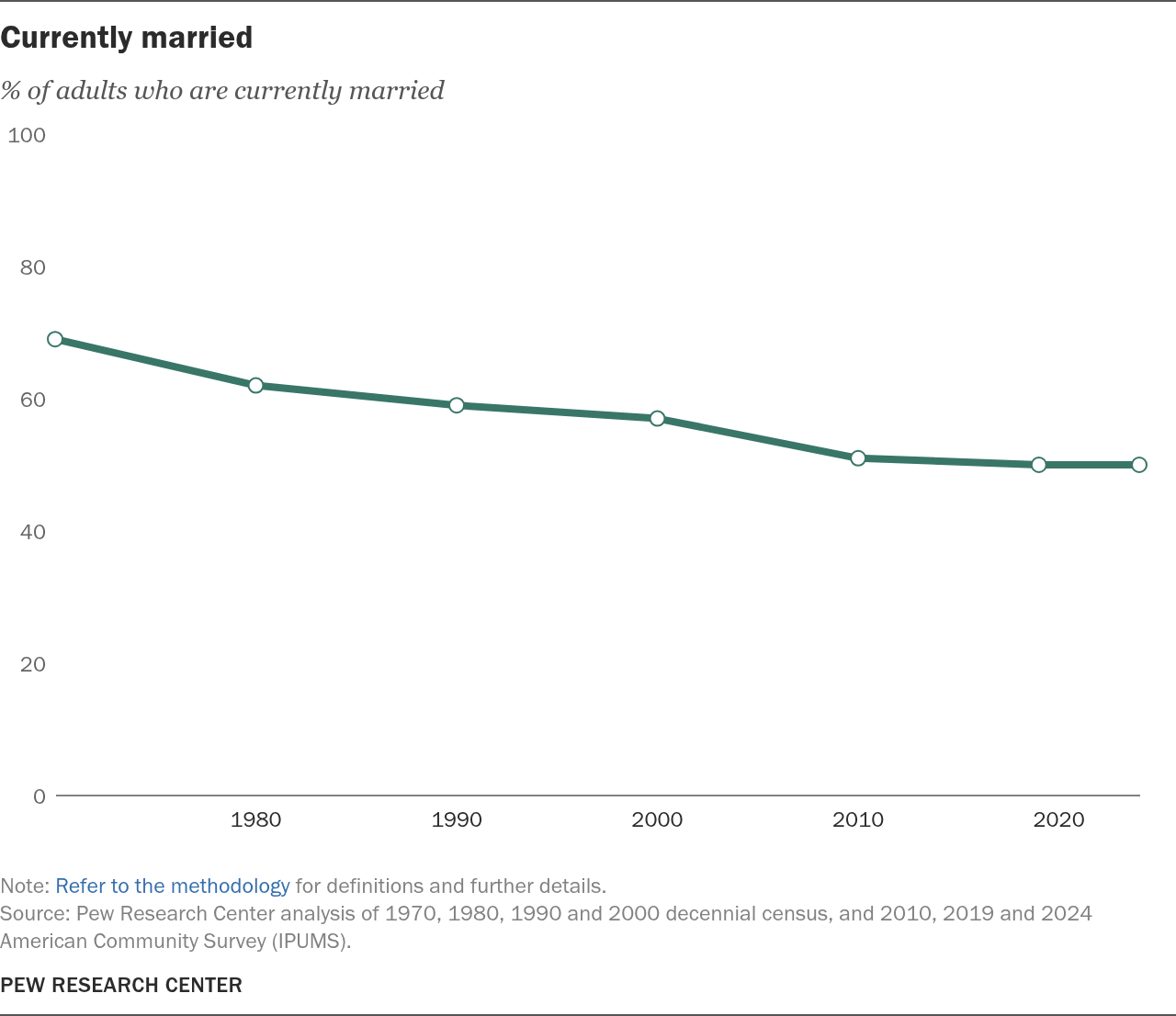 Note: Refer to the methodology for definitions and further details. Source: Pew Research Center analysis of 1970, 1980, 1990 and 2000 decennial census, and 2010, 2019 and 2024 American Community Survey (IPUMS).PEW RESEARCH CENTER
Note: Refer to the methodology for definitions and further details. Source: Pew Research Center analysis of 1970, 1980, 1990 and 2000 decennial census, and 2010, 2019 and 2024 American Community Survey (IPUMS).PEW RESEARCH CENTER
Share this chart
Currently married% of adults who are currently married
| Year | All |
|---|---|
| 1970 | 69% |
| 1980 | 62% |
| 1990 | 59% |
| 2000 | 57% |
| 2010 | 51% |
| 2019 | 50% |
| 2024 | 50% |
Download data as .csvNote: Refer to the methodology for definitions and further details. Source: Pew Research Center analysis of 1970, 1980, 1990 and 2000 decennial census, and 2010, 2019 and 2024 American Community Survey (IPUMS).PEW RESEARCH CENTER
Currently married% of adults ages 25 and older who are currently married, by education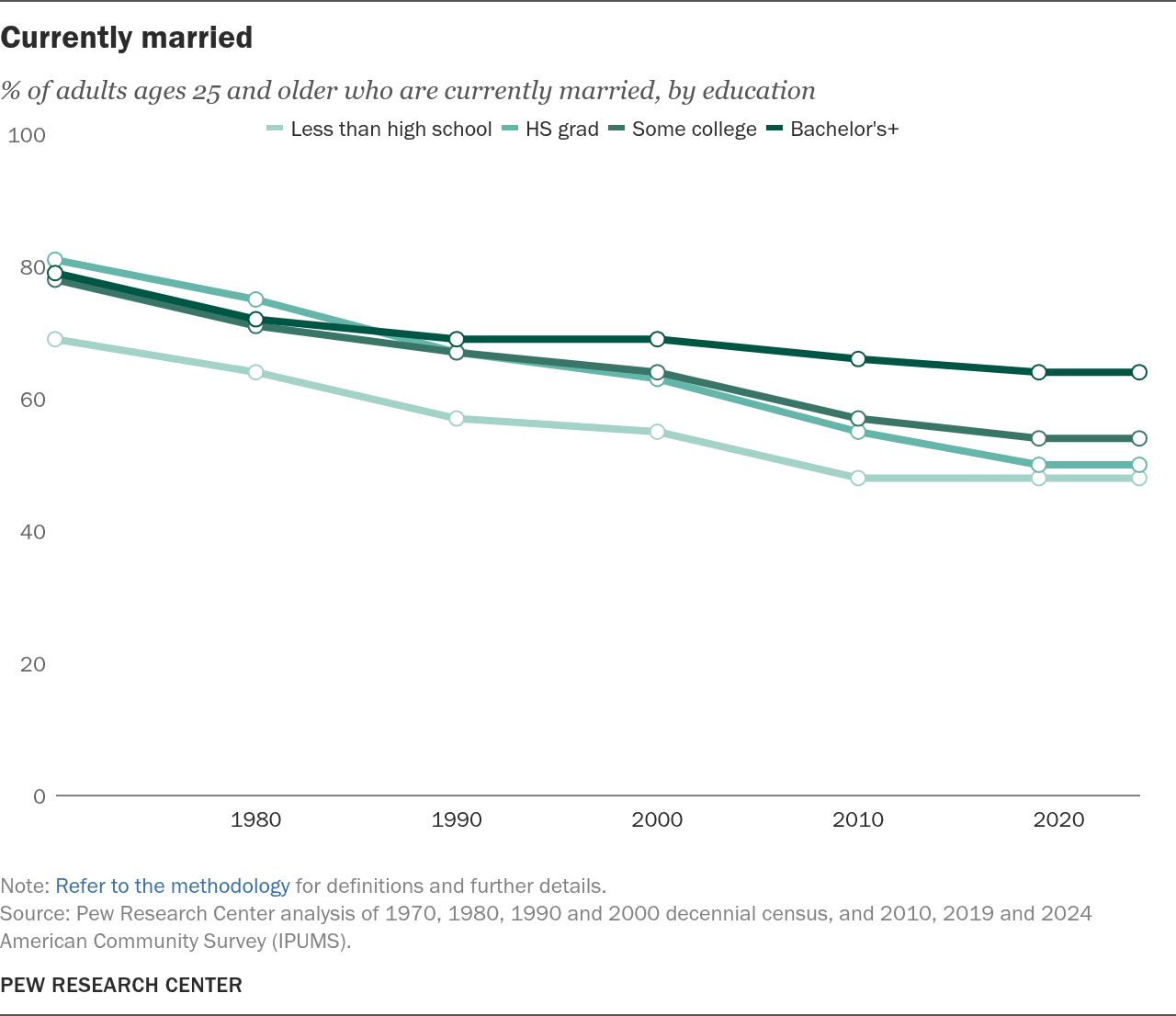 Note: Refer to the methodology for definitions and further details. Source: Pew Research Center analysis of 1970, 1980, 1990 and 2000 decennial census, and 2010, 2019 and 2024 American Community Survey (IPUMS).PEW RESEARCH CENTER
Note: Refer to the methodology for definitions and further details. Source: Pew Research Center analysis of 1970, 1980, 1990 and 2000 decennial census, and 2010, 2019 and 2024 American Community Survey (IPUMS).PEW RESEARCH CENTER
Share this chart
Currently married% of adults ages 25 and older who are currently married, by education
| Year | Less than high school | HS grad | Some college | Bachelor’s+ |
|---|---|---|---|---|
| 1970 | 69% | 81% | 78% | 79% |
| 1980 | 64% | 75% | 71% | 72% |
| 1990 | 57% | 67% | 67% | 69% |
| 2000 | 55% | 63% | 64% | 69% |
| 2010 | 48% | 55% | 57% | 66% |
| 2019 | 48% | 50% | 54% | 64% |
| 2024 | 48% | 50% | 54% | 64% |
Download data as .csvNote: Refer to the methodology for definitions and further details. Source: Pew Research Center analysis of 1970, 1980, 1990 and 2000 decennial census, and 2010, 2019 and 2024 American Community Survey (IPUMS).PEW RESEARCH CENTER
Currently married% of adults who are currently married, by race/ethnicity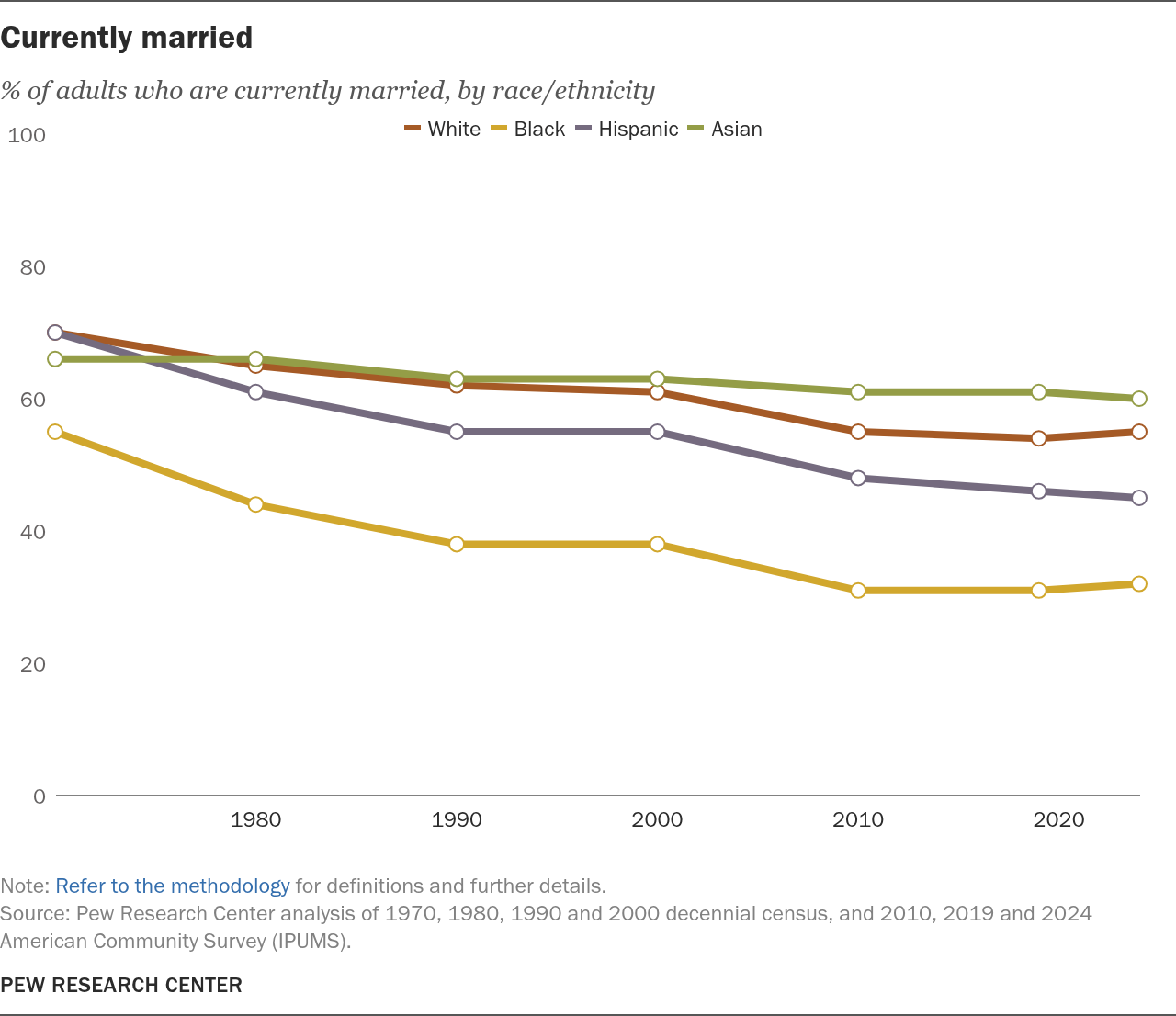 Note: Refer to the methodology for definitions and further details. Source: Pew Research Center analysis of 1970, 1980, 1990 and 2000 decennial census, and 2010, 2019 and 2024 American Community Survey (IPUMS).PEW RESEARCH CENTER
Note: Refer to the methodology for definitions and further details. Source: Pew Research Center analysis of 1970, 1980, 1990 and 2000 decennial census, and 2010, 2019 and 2024 American Community Survey (IPUMS).PEW RESEARCH CENTER
Share this chart
Currently married% of adults who are currently married, by race/ethnicity
| Year | White | Black | Hispanic | Asian |
|---|---|---|---|---|
| 1970 | 70% | 55% | 70% | 66% |
| 1980 | 65% | 44% | 61% | 66% |
| 1990 | 62% | 38% | 55% | 63% |
| 2000 | 61% | 38% | 55% | 63% |
| 2010 | 55% | 31% | 48% | 61% |
| 2019 | 54% | 31% | 46% | 61% |
| 2024 | 55% | 32% | 45% | 60% |
Download data as .csvNote: Refer to the methodology for definitions and further details. Source: Pew Research Center analysis of 1970, 1980, 1990 and 2000 decennial census, and 2010, 2019 and 2024 American Community Survey (IPUMS).PEW RESEARCH CENTER
Частка дорослих віком 50 років і старше, які ніколи не були одружені, дещо зросла з 1970 року. Найбільше зростання спостерігалося серед чорношкірих дорослих, де частка тих, хто ніколи не був одружений, потрійнулася за цей період.
Never married% of adults ages 50 and older who have never been married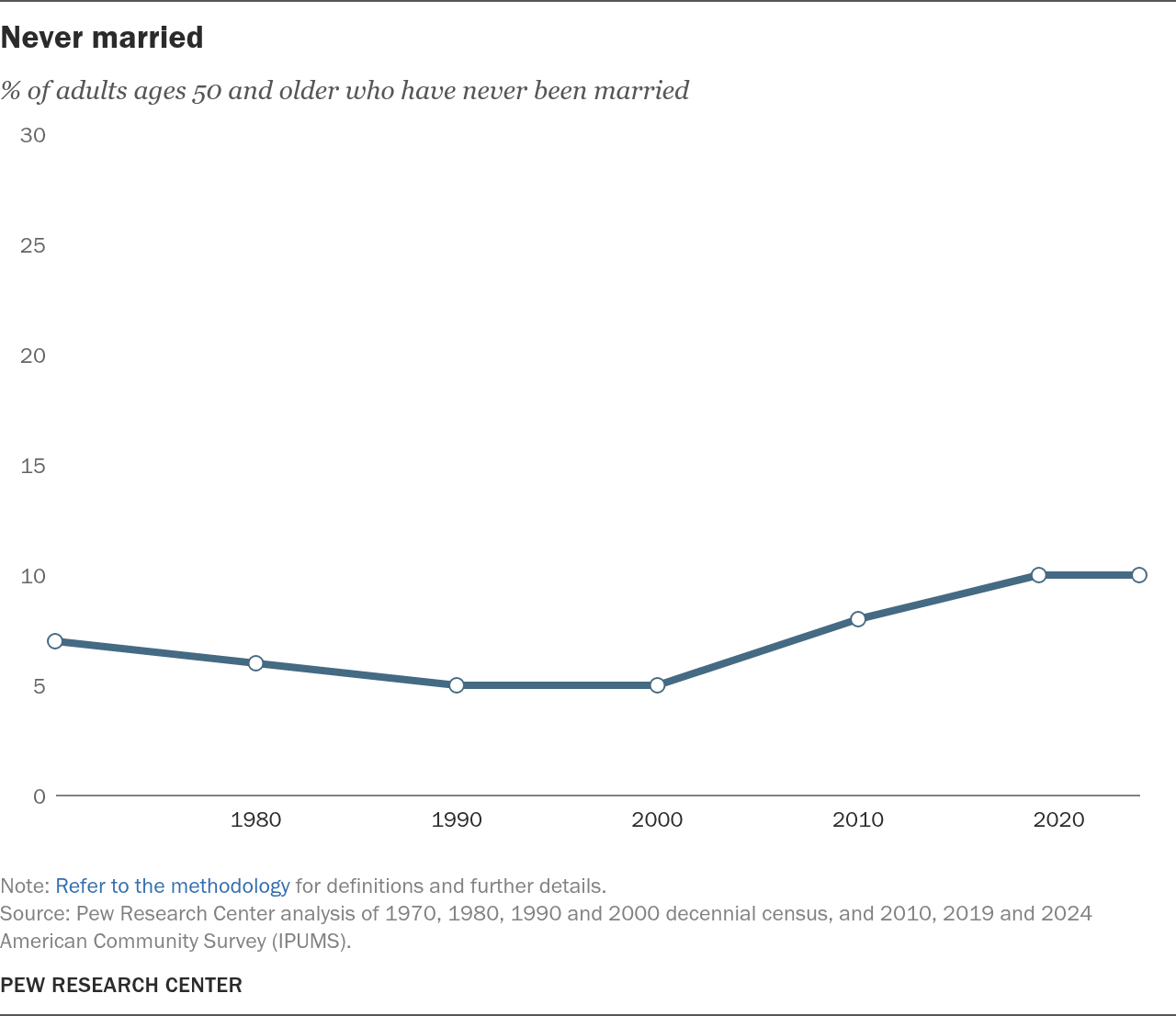 Note: Refer to the methodology for definitions and further details. Source: Pew Research Center analysis of 1970, 1980, 1990 and 2000 decennial census, and 2010, 2019 and 2024 American Community Survey (IPUMS).PEW RESEARCH CENTER
Note: Refer to the methodology for definitions and further details. Source: Pew Research Center analysis of 1970, 1980, 1990 and 2000 decennial census, and 2010, 2019 and 2024 American Community Survey (IPUMS).PEW RESEARCH CENTER
Share this chart
Never married% of adults ages 50 and older who have never been married
| Year | All |
|---|---|
| 1970 | 7% |
| 1980 | 6% |
| 1990 | 5% |
| 2000 | 5% |
| 2010 | 8% |
| 2019 | 10% |
| 2024 | 10% |
Download data as .csvNote: Refer to the methodology for definitions and further details. Source: Pew Research Center analysis of 1970, 1980, 1990 and 2000 decennial census, and 2010, 2019 and 2024 American Community Survey (IPUMS).PEW RESEARCH CENTER
Never married% of adults ages 50 and older who have never been married, by education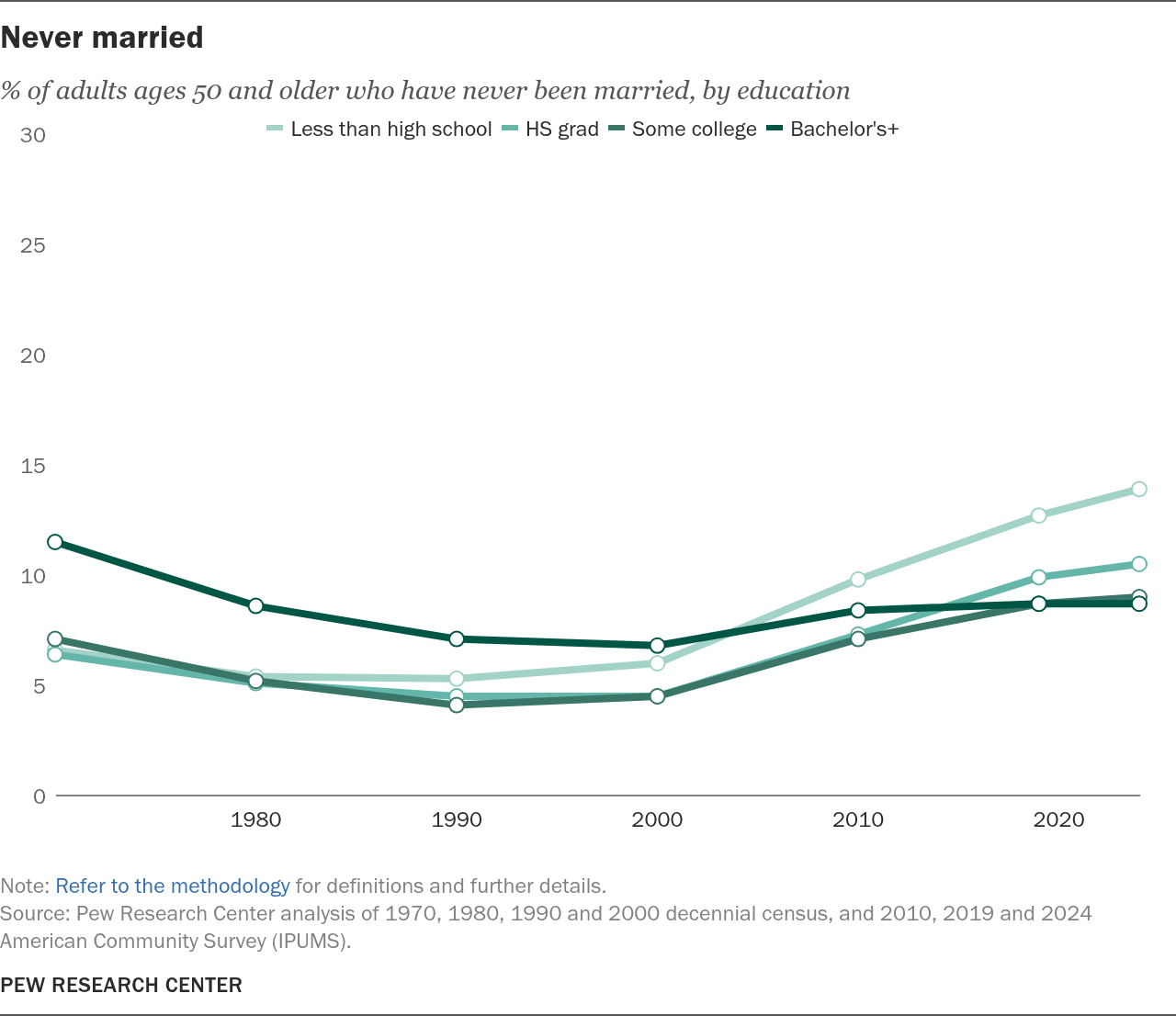 Note: Refer to the methodology for definitions and further details. Source: Pew Research Center analysis of 1970, 1980, 1990 and 2000 decennial census, and 2010, 2019 and 2024 American Community Survey (IPUMS).PEW RESEARCH CENTER
Note: Refer to the methodology for definitions and further details. Source: Pew Research Center analysis of 1970, 1980, 1990 and 2000 decennial census, and 2010, 2019 and 2024 American Community Survey (IPUMS).PEW RESEARCH CENTER
Share this chart
Never married% of adults ages 50 and older who have never been married, by education
| Year | Less than high school | HS grad | Some college | Bachelor’s+ |
|---|---|---|---|---|
| 1970 | 6.6% | 6.4% | 7.1% | 11.5% |
| 1980 | 5.4% | 5.1% | 5.2% | 8.6% |
| 1990 | 5.3% | 4.5% | 4.1% | 7.1% |
| 2000 | 6.0% | 4.5% | 4.5% | 6.8% |
| 2010 | 9.8% | 7.3% | 7.1% | 8.4% |
| 2019 | 12.7% | 9.9% | 8.7% | 8.7% |
| 2024 | 13.9% | 10.5% | 9.0% | 8.7% |
Download data as .csvNote: Refer to the methodology for definitions and further details. Source: Pew Research Center analysis of 1970, 1980, 1990 and 2000 decennial census, and 2010, 2019 and 2024 American Community Survey (IPUMS).PEW RESEARCH CENTER
Never married% of adults ages 50 and older who have never been married, by race/ethnicity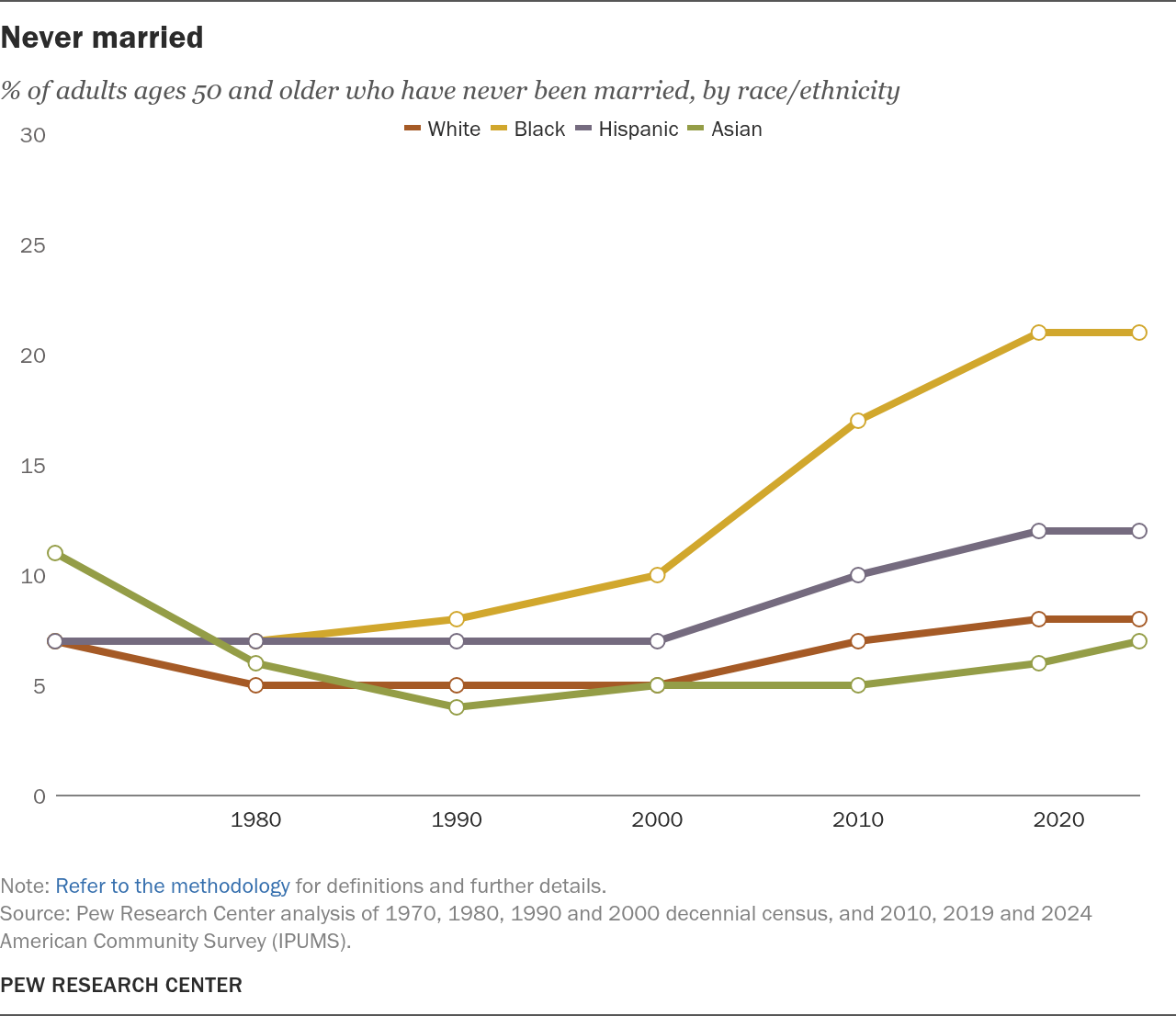 Note: Refer to the methodology for definitions and further details. Source: Pew Research Center analysis of 1970, 1980, 1990 and 2000 decennial census, and 2010, 2019 and 2024 American Community Survey (IPUMS).PEW RESEARCH CENTER
Note: Refer to the methodology for definitions and further details. Source: Pew Research Center analysis of 1970, 1980, 1990 and 2000 decennial census, and 2010, 2019 and 2024 American Community Survey (IPUMS).PEW RESEARCH CENTER
Share this chart
Never married% of adults ages 50 and older who have never been married, by race/ethnicity
| Year | White | Black | Hispanic | Asian |
|---|---|---|---|---|
| 1970 | 7% | 7% | 7% | 11% |
| 1980 | 5% | 7% | 7% | 6% |
| 1990 | 5% | 8% | 7% | 4% |
| 2000 | 5% | 10% | 7% | 5% |
| 2010 | 7% | 17% | 10% | 5% |
| 2019 | 8% | 21% | 12% | 6% |
| 2024 | 8% | 21% | 12% | 7% |
Download data as .csvNote: Refer to the methodology for definitions and further details. Source: Pew Research Center analysis of 1970, 1980, 1990 and 2000 decennial census, and 2010, 2019 and 2024 American Community Survey (IPUMS).PEW RESEARCH CENTER
Зниження народжуваності
Народжуваність, виміряна тут як середня кількість дітей, народжених жінками віком від 40 до 44 років, знизилася, частково через появу протизаплідних пігулок, затримку шлюбу та зростання зайнятості жінок. П’ятдесят років тому американки мали в середньому близько трьох дітей, а з 1990 року ця цифра коливається близько двох дітей.
Number of childrenAverage number of lifetime births among women ages 40 to 44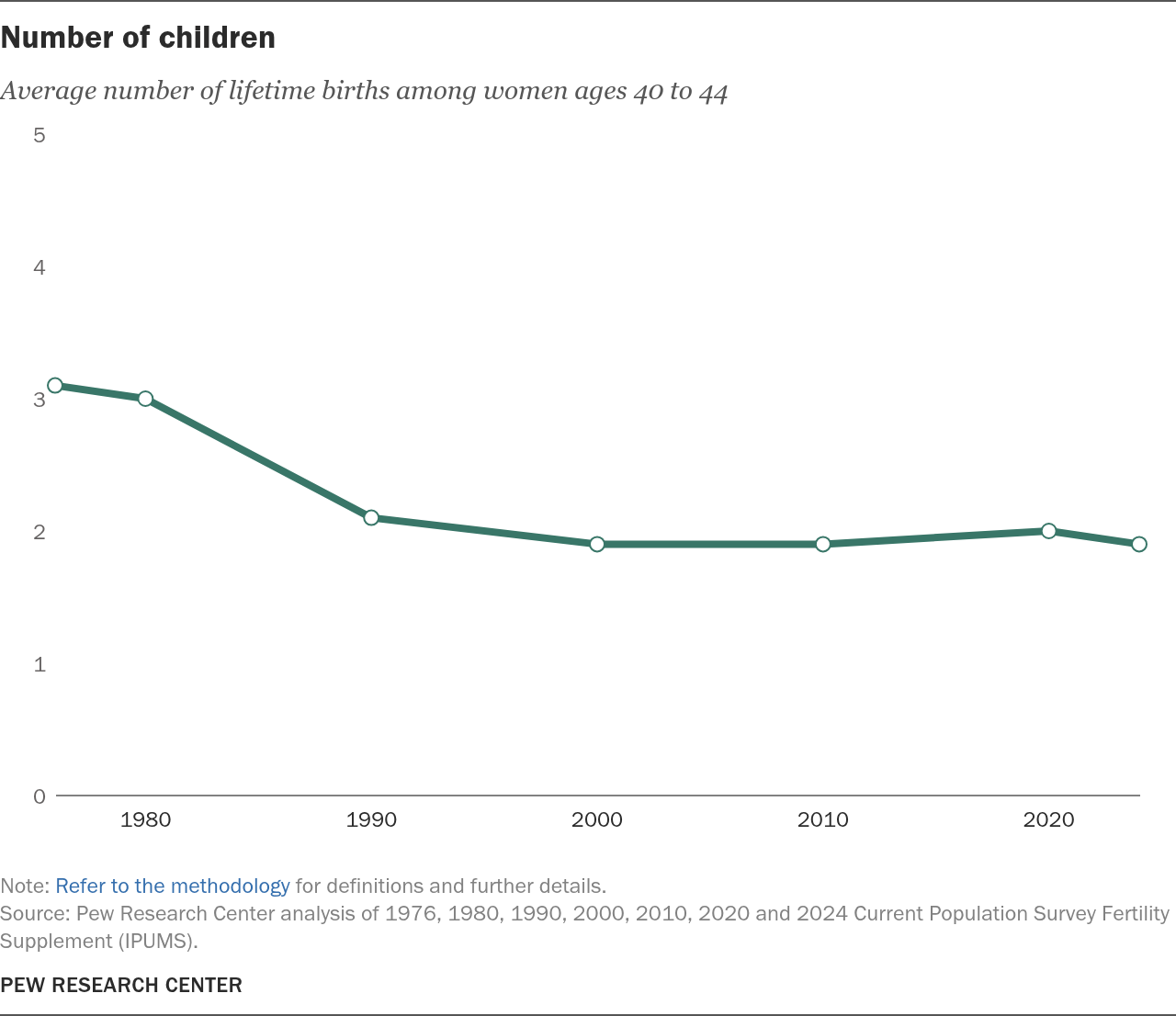 Note: Refer to the methodology for definitions and further details. Source: Pew Research Center analysis of 1976, 1980, 1990, 2000, 2010, 2020 and 2024 Current Population Survey Fertility Supplement (IPUMS).PEW RESEARCH CENTER
Note: Refer to the methodology for definitions and further details. Source: Pew Research Center analysis of 1976, 1980, 1990, 2000, 2010, 2020 and 2024 Current Population Survey Fertility Supplement (IPUMS).PEW RESEARCH CENTER
Share this chart
Number of childrenAverage number of lifetime births among women ages 40 to 44
| Year | All |
|---|---|
| 1976 | 3.1 |
| 1980 | 3.0 |
| 1990 | 2.1 |
| 2000 | 1.9 |
| 2010 | 1.9 |
| 2020 | 2.0 |
| 2024 | 1.9 |
Download data as .csvNote: Refer to the methodology for definitions and further details. Source: Pew Research Center analysis of 1976, 1980, 1990, 2000, 2010, 2020 and 2024 Current Population Survey Fertility Supplement (IPUMS).PEW RESEARCH CENTER
Number of childrenAverage number of lifetime births among women ages 40 to 44, by education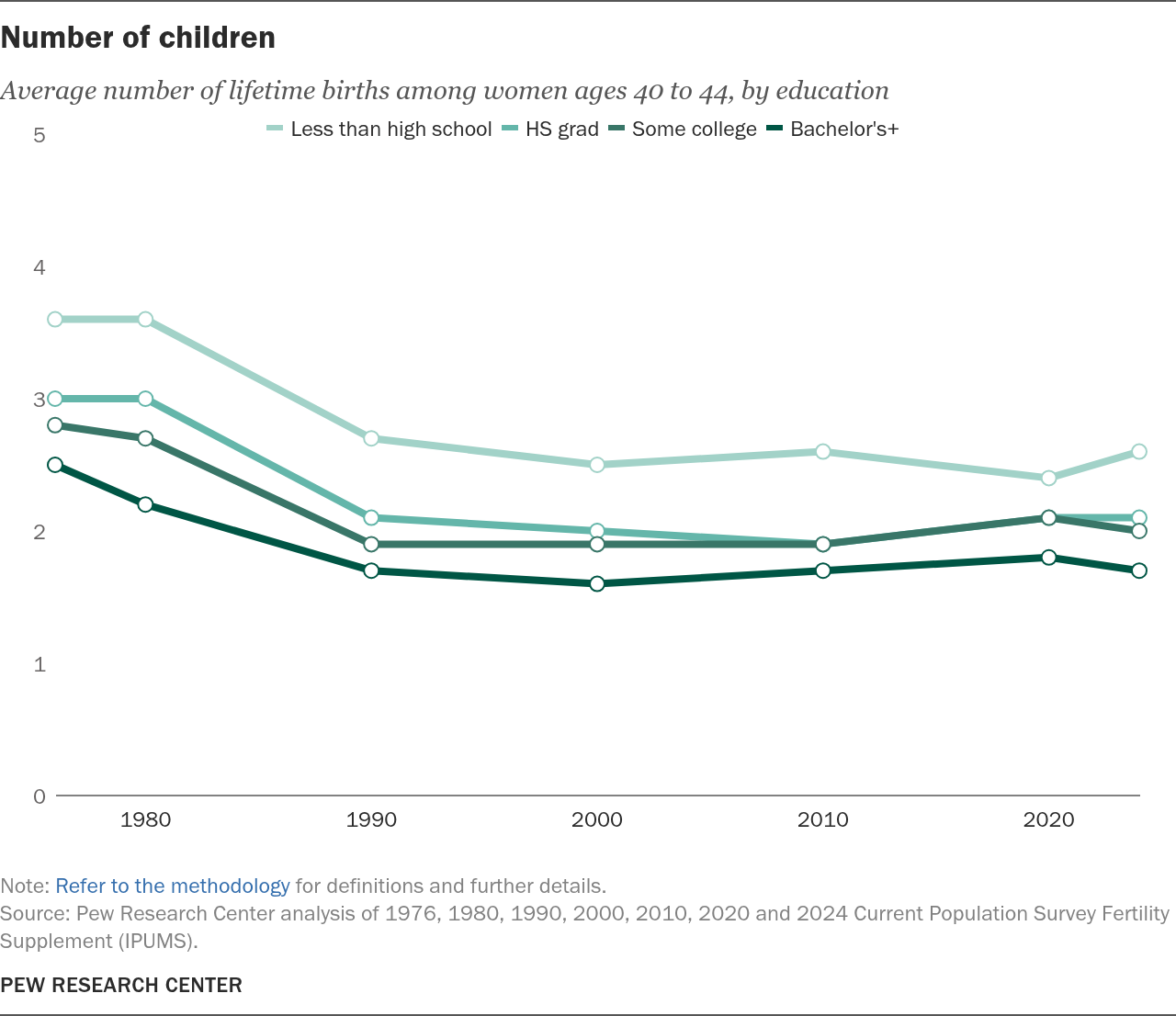 Note: Refer to the methodology for definitions and further details. Source: Pew Research Center analysis of 1976, 1980, 1990, 2000, 2010, 2020 and 2024 Current Population Survey Fertility Supplement (IPUMS).PEW RESEARCH CENTER
Note: Refer to the methodology for definitions and further details. Source: Pew Research Center analysis of 1976, 1980, 1990, 2000, 2010, 2020 and 2024 Current Population Survey Fertility Supplement (IPUMS).PEW RESEARCH CENTER
Share this chart
Number of childrenAverage number of lifetime births among women ages 40 to 44, by education
| Year | Less than high school | HS grad | Some college | Bachelor’s+ |
|---|---|---|---|---|
| 1976 | 3.6 | 3.0 | 2.8 | 2.5 |
| 1980 | 3.6 | 3.0 | 2.7 | 2.2 |
| 1990 | 2.7 | 2.1 | 1.9 | 1.7 |
| 2000 | 2.5 | 2.0 | 1.9 | 1.6 |
| 2010 | 2.6 | 1.9 | 1.9 | 1.7 |
| 2020 | 2.4 | 2.1 | 2.1 | 1.8 |
| 2024 | 2.6 | 2.1 | 2.0 | 1.7 |
Download data as .csvNote: Refer to the methodology for definitions and further details. Source: Pew Research Center analysis of 1976, 1980, 1990, 2000, 2010, 2020 and 2024 Current Population Survey Fertility Supplement (IPUMS).PEW RESEARCH CENTER
Number of childrenAverage number of lifetime births among women ages 40 to 44, by race/ethnicity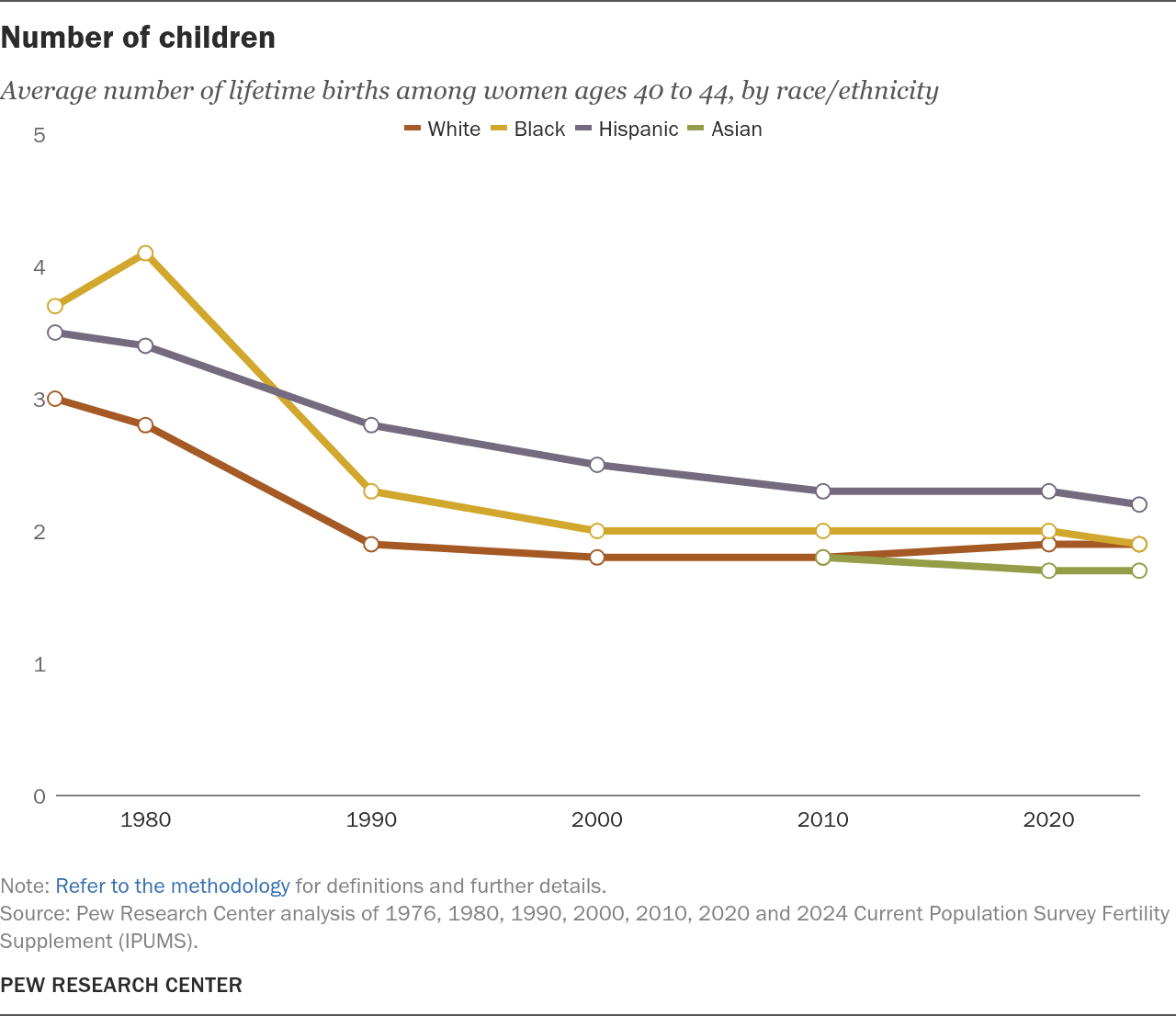 Note: Refer to the methodology for definitions and further details. Source: Pew Research Center analysis of 1976, 1980, 1990, 2000, 2010, 2020 and 2024 Current Population Survey Fertility Supplement (IPUMS).PEW RESEARCH CENTER
Note: Refer to the methodology for definitions and further details. Source: Pew Research Center analysis of 1976, 1980, 1990, 2000, 2010, 2020 and 2024 Current Population Survey Fertility Supplement (IPUMS).PEW RESEARCH CENTER
Share this chart
Number of childrenAverage number of lifetime births among women ages 40 to 44, by race/ethnicity
| Year | White | Black | Hispanic | Asian |
|---|---|---|---|---|
| 1976 | 3.0 | 3.7 | 3.5 | |
| 1980 | 2.8 | 4.1 | 3.4 | |
| 1990 | 1.9 | 2.3 | 2.8 | |
| 2000 | 1.8 | 2.0 | 2.5 | |
| 2010 | 1.8 | 2.0 | 2.3 | 1.8 |
| 2020 | 1.9 | 2.0 | 2.3 | 1.7 |
| 2024 | 1.9 | 1.9 | 2.2 | 1.7 |
Download data as .csvNote: Refer to the methodology for definitions and further details. Source: Pew Research Center analysis of 1976, 1980, 1990, 2000, 2010, 2020 and 2024 Current Population Survey Fertility Supplement (IPUMS).PEW RESEARCH CENTER
Зміни в американській родині
Діти в США сьогодні значно рідше живуть з обома одруженими батьками, ніж 50 років тому. Ця зміна відбулася в усіх расових та етнічних групах, за винятком домогосподарств, керованих дорослими азійського походження, де ця частка залишилася майже незмінною.
Children living with two married parents% of children younger than 18 who live with two married parents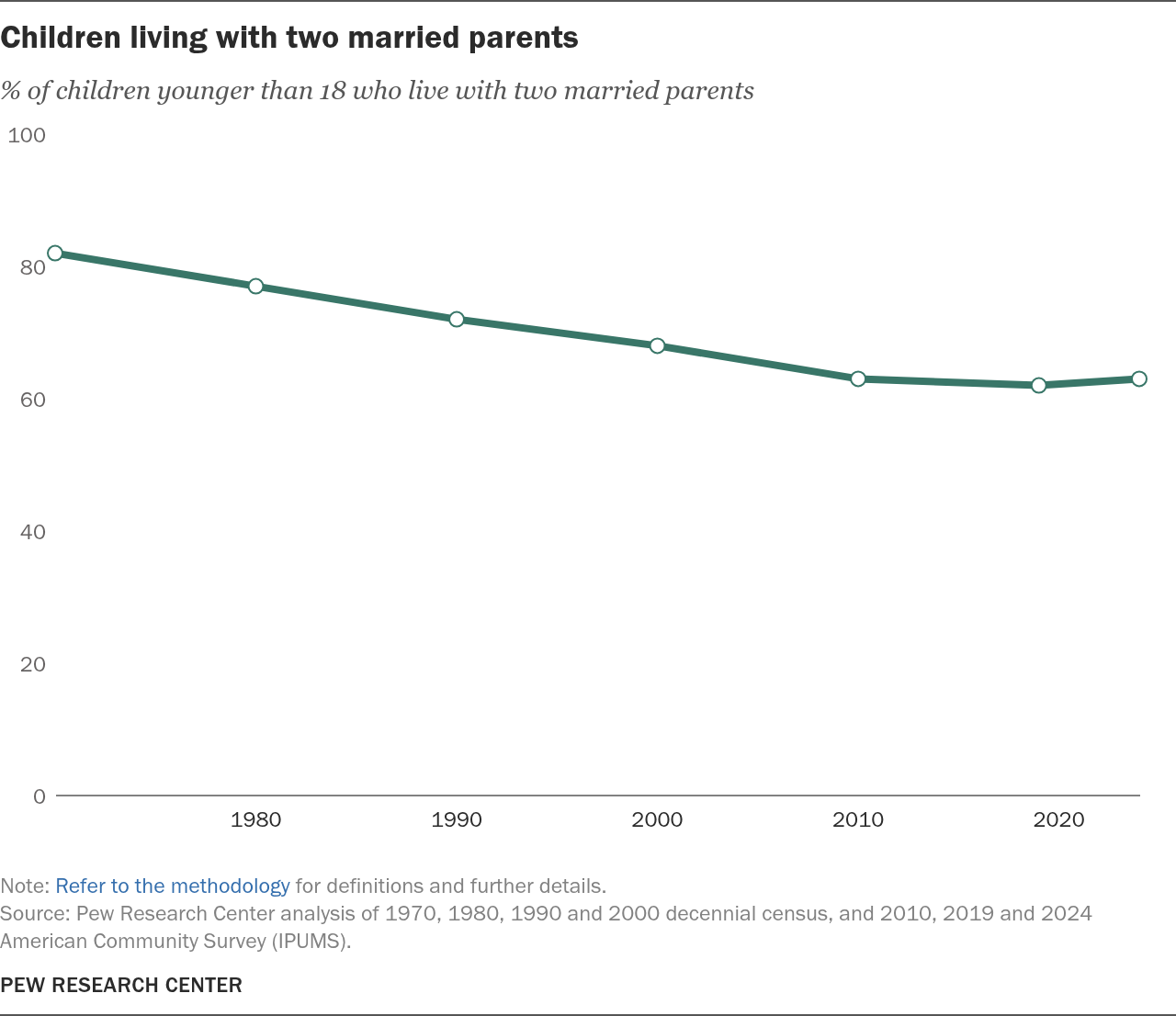 Note: Refer to the methodology for definitions and further details. Source: Pew Research Center analysis of 1970, 1980, 1990 and 2000 decennial census, and 2010, 2019 and 2024 American Community Survey (IPUMS).PEW RESEARCH CENTER
Note: Refer to the methodology for definitions and further details. Source: Pew Research Center analysis of 1970, 1980, 1990 and 2000 decennial census, and 2010, 2019 and 2024 American Community Survey (IPUMS).PEW RESEARCH CENTER
Share this chart
Children living with two married parents% of children younger than 18 who live with two married parents
| Year | All |
|---|---|
| 1970 | 82% |
| 1980 | 77% |
| 1990 | 72% |
| 2000 | 68% |
| 2010 | 63% |
| 2019 | 62% |
| 2024 | 63% |
Download data as .csvNote: Refer to the methodology for definitions and further details. Source: Pew Research Center analysis of 1970, 1980, 1990 and 2000 decennial census, and 2010, 2019 and 2024 American Community Survey (IPUMS).PEW RESEARCH CENTER
Children living with two married parents% of children younger than 18 who live with two married parents, by parents’ education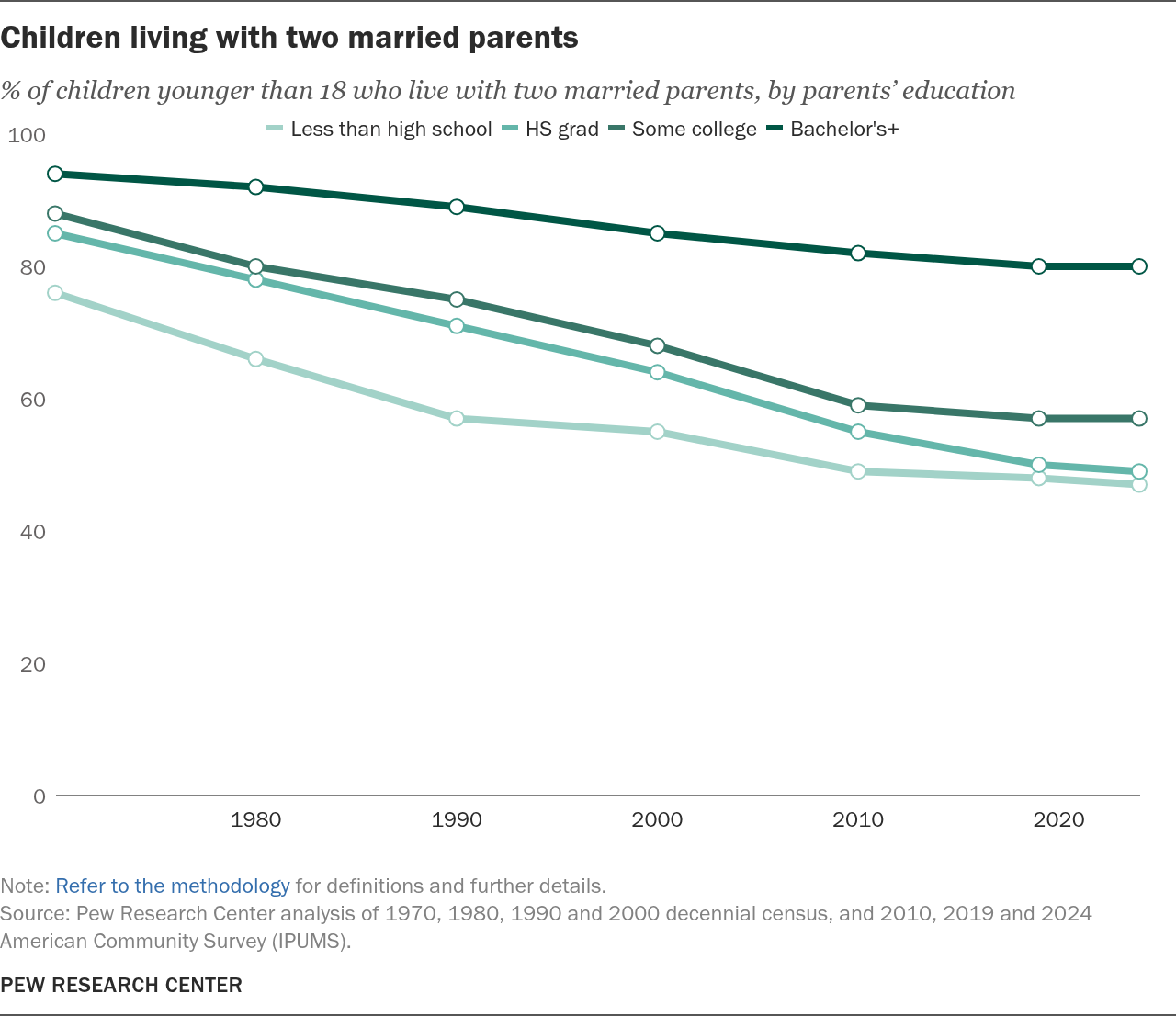 Note: Refer to the methodology for definitions and further details. Source: Pew Research Center analysis of 1970, 1980, 1990 and 2000 decennial census, and 2010, 2019 and 2024 American Community Survey (IPUMS).PEW RESEARCH CENTER
Note: Refer to the methodology for definitions and further details. Source: Pew Research Center analysis of 1970, 1980, 1990 and 2000 decennial census, and 2010, 2019 and 2024 American Community Survey (IPUMS).PEW RESEARCH CENTER
Share this chart
Children living with two married parents% of children younger than 18 who live with two married parents, by parents’ education
| Year | Less than high school | HS grad | Some college | Bachelor’s+ |
|---|---|---|---|---|
| 1970 | 76% | 85% | 88% | 94% |
| 1980 | 66% | 78% | 80% | 92% |
| 1990 | 57% | 71% | 75% | 89% |
| 2000 | 55% | 64% | 68% | 85% |
| 2010 | 49% | 55% | 59% | 82% |
| 2019 | 48% | 50% | 57% | 80% |
| 2024 | 47% | 49% | 57% | 80% |
Download data as .csvNote: Refer to the methodology for definitions and further details. Source: Pew Research Center analysis of 1970, 1980, 1990 and 2000 decennial census, and 2010, 2019 and 2024 American Community Survey (IPUMS).PEW RESEARCH CENTER
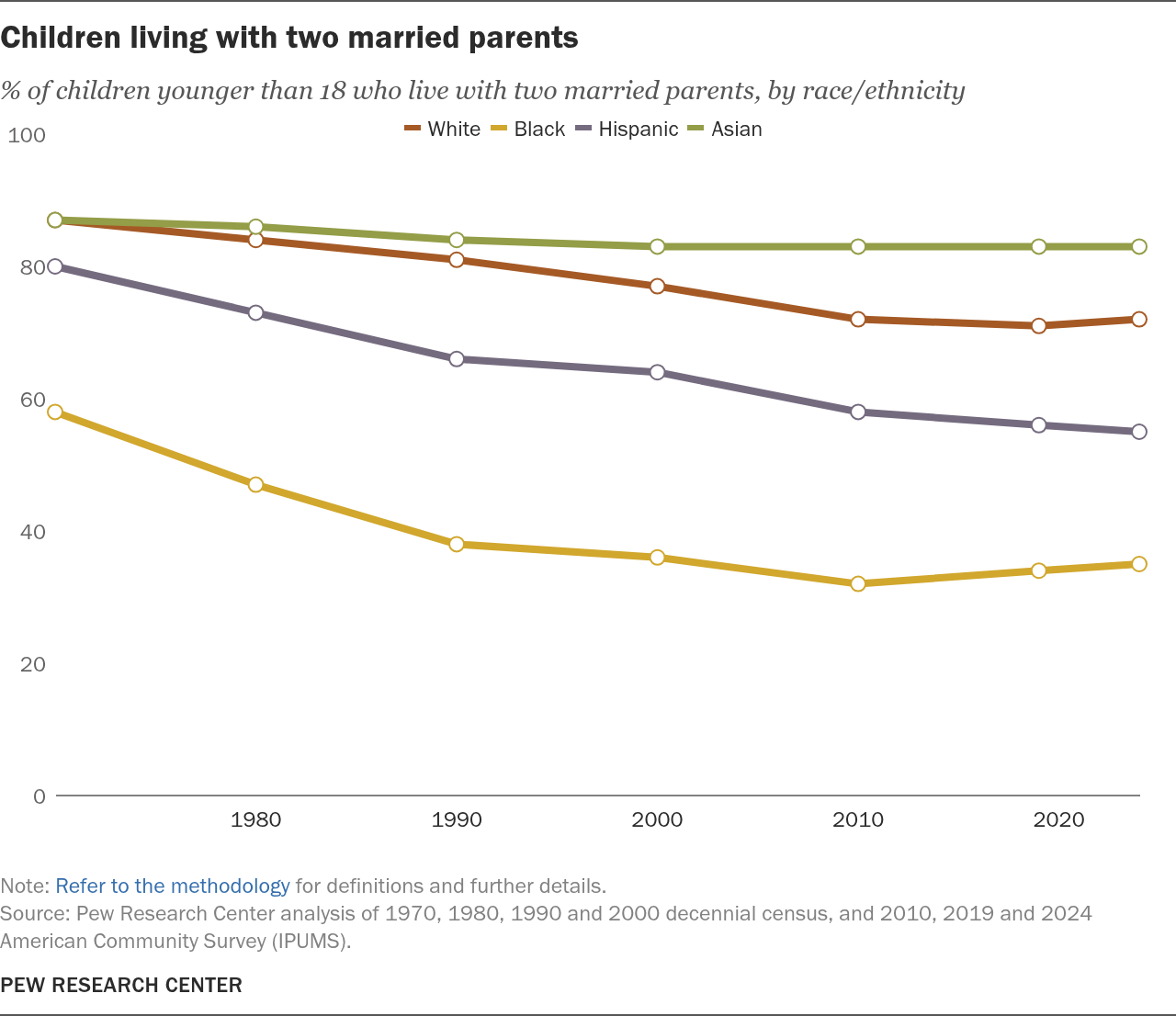 Note: Refer to the methodology for definitions and further details. Source: Pew Research Center analysis of 1970, 1980, 1990 and 2000 decennial census, and 2010, 2019 and 2024 American Community Survey (IPUMS).PEW RESEARCH CENTER
Share this chart
Children living with two married parents% of children younger than 18 who live with two married parents, by race/ethnicity
| Year | White | Black | Hispanic | Asian |
|---|---|---|---|---|
| 1970 | 87% | 58% | 80% | 87% |
| 1980 | 84% | 47% | 73% | 86% |
| 1990 | 81% | 38% | 66% | 84% |
| 2000 | 77% | 36% | 64% | 83% |
| 2010 | 72% | 32% | 58% | 83% |
| 2019 | 71% | 34% | 56% | 83% |
| 2024 | 72% | 35% | 55% | 83% |
Download data as .csvNote: Refer to the methodology for definitions and further details. Source: Pew Research Center analysis of 1970, 1980, 1990 and 2000 decennial census, and 2010, 2019 and 2024 American Community Survey (IPUMS).PEW RESEARCH CENTER
Більше поколінь під одним дахом
Частка американців, які проживають у домогосподарствах з більш ніж одним поколінням дорослих, або в багатопоколіннєвих домогосподарствах, суттєво зросла з 1970 року. Це зростання було більшим серед афроамериканців, латиноамериканців та азіатів (досягнувши майже 30%), ніж серед білих американців (зрісши до 16%).
Population in multigenerational households % of total population living in multigenerational households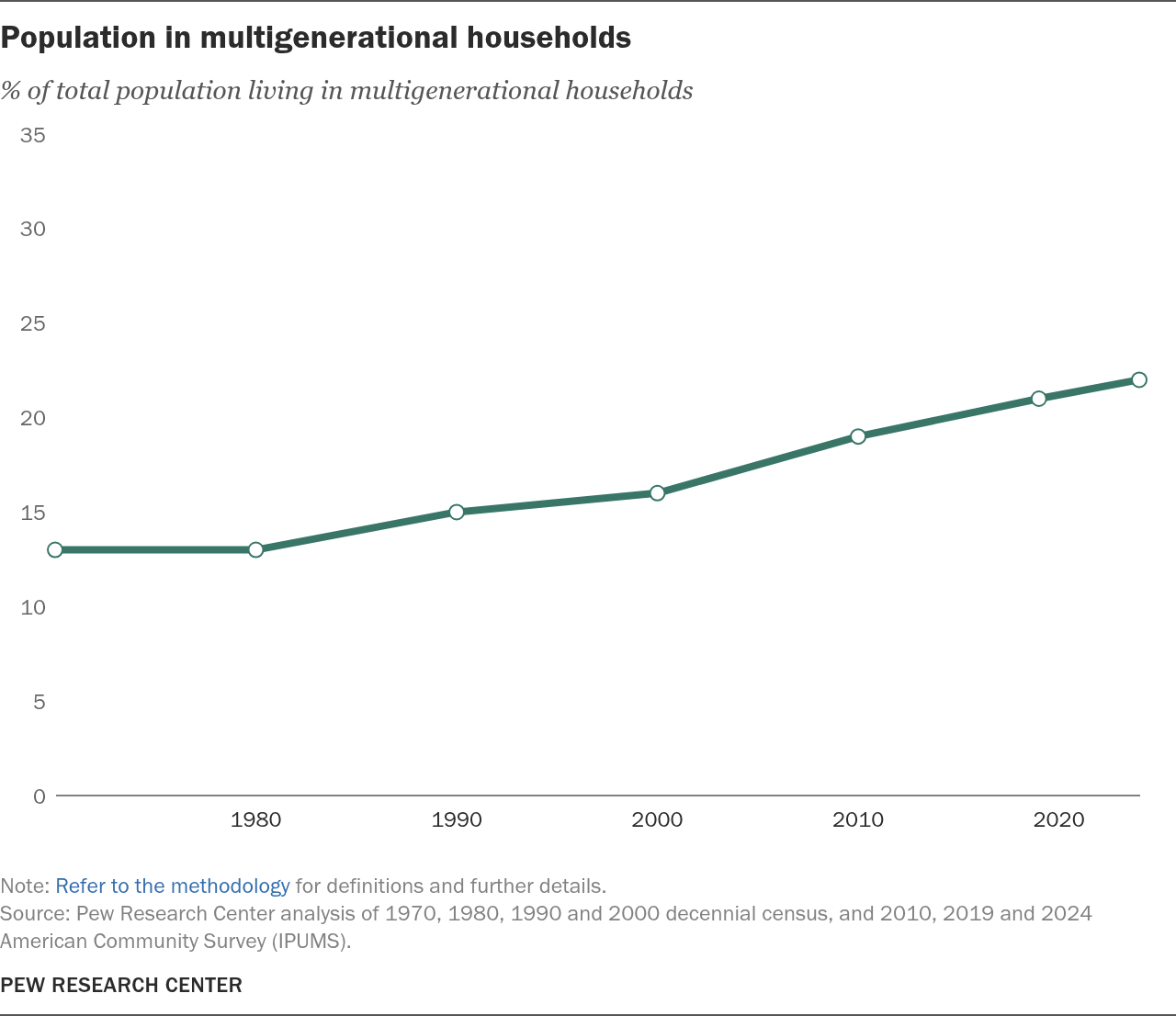 Note: Refer to the methodology for definitions and further details. Source: Pew Research Center analysis of 1970, 1980, 1990 and 2000 decennial census, and 2010, 2019 and 2024 American Community Survey (IPUMS).PEW RESEARCH CENTER
Note: Refer to the methodology for definitions and further details. Source: Pew Research Center analysis of 1970, 1980, 1990 and 2000 decennial census, and 2010, 2019 and 2024 American Community Survey (IPUMS).PEW RESEARCH CENTER
Share this chart
Population in multigenerational households % of total population living in multigenerational households
| Year | All |
|---|---|
| 1970 | 13% |
| 1980 | 13% |
| 1990 | 15% |
| 2000 | 16% |
| 2010 | 19% |
| 2019 | 21% |
| 2024 | 22% |
Download data as .csvNote: Refer to the methodology for definitions and further details. Source: Pew Research Center analysis of 1970, 1980, 1990 and 2000 decennial census, and 2010, 2019 and 2024 American Community Survey (IPUMS).PEW RESEARCH CENTER
Population in multigenerational households % of total population living in multigenerational households, by race/ethnicity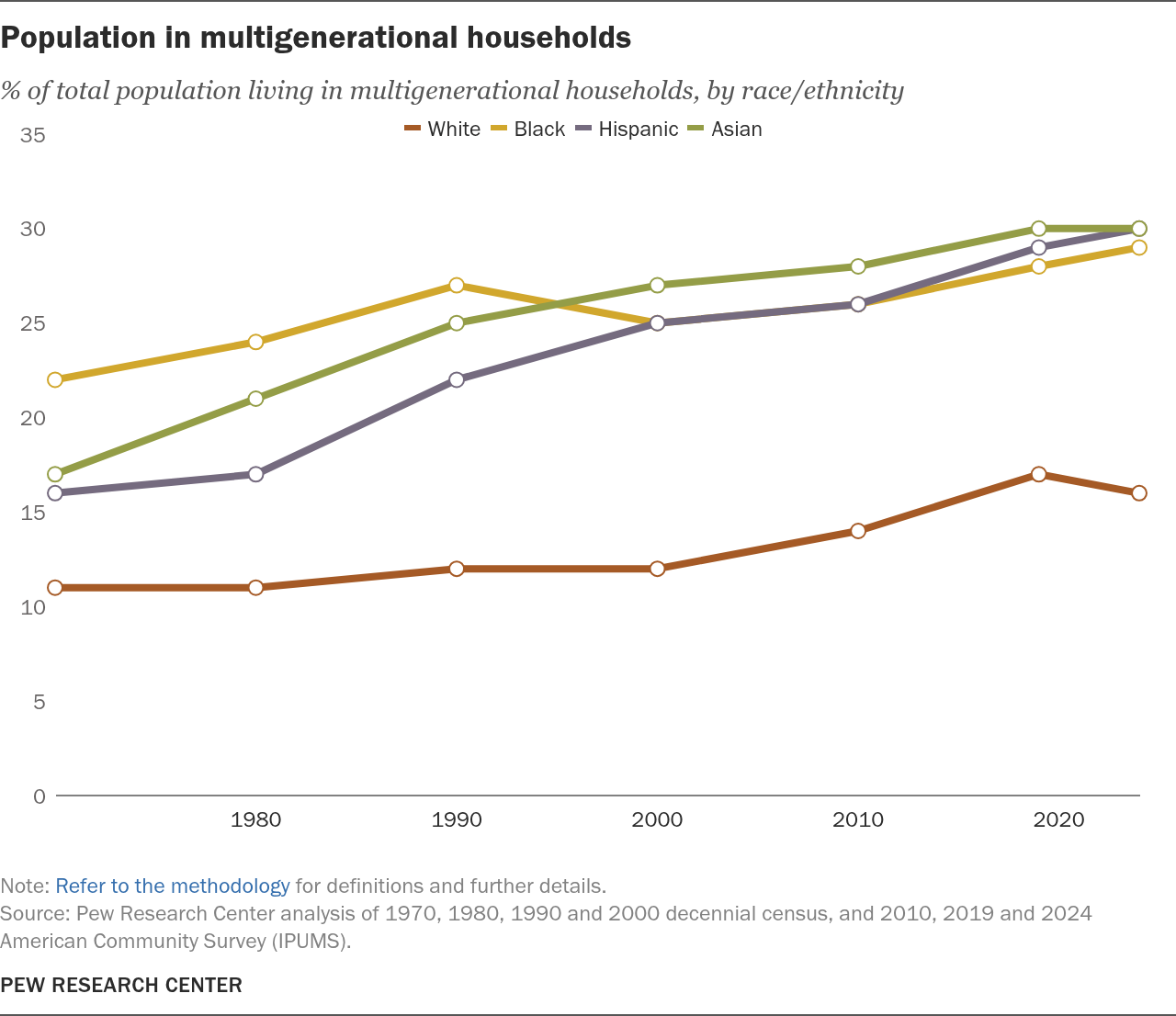 Note: Refer to the methodology for definitions and further details. Source: Pew Research Center analysis of 1970, 1980, 1990 and 2000 decennial census, and 2010, 2019 and 2024 American Community Survey (IPUMS).PEW RESEARCH CENTER
Note: Refer to the methodology for definitions and further details. Source: Pew Research Center analysis of 1970, 1980, 1990 and 2000 decennial census, and 2010, 2019 and 2024 American Community Survey (IPUMS).PEW RESEARCH CENTER
Share this chart
Population in multigenerational households % of total population living in multigenerational households, by race/ethnicity
| Year | White | Black | Asian | Hispanic |
|---|---|---|---|---|
| 1970 | 11% | 22% | 17% | 16% |
| 1980 | 11% | 24% | 21% | 17% |
| 1990 | 12% | 27% | 25% | 22% |
| 2000 | 12% | 25% | 27% | 25% |
| 2010 | 14% | 26% | 28% | 26% |
| 2019 | 17% | 28% | 30% | 29% |
| 2024 | 16% | 29% | 30% | 30% |
Download data as .csvNote: Refer to the methodology for definitions and further details. Source: Pew Research Center analysis of 1970, 1980, 1990 and 2000 decennial census, and 2010, 2019 and 2024 American Community Survey (IPUMS).PEW RESEARCH CENTER

Економіка
Нью-Йоркська фондова біржа у 1973 році. Понад 50 років потому, Нью-Йоркська фондова біржа у 2024 році. (PL Gould/Images Press, Angela Weiss через Getty Images)
Наскільки покращилися американські стандарти життя з 1970 року, частково залежить від показників. З ростом економіки частка бідних американців зменшилася, а бідність серед літніх людей особливо різко знизилася. Водночас середній клас скоротився, а частка дорослих у нижчому класі зросла. А частка власників житла зросла лише незначно.
Скорочення середнього класу
Відсоток дорослих у середньому класі зменшився з 1970 року, оскільки частка як у нижчому, так і у вищому доході зросла.
Income class% of adults in each income tier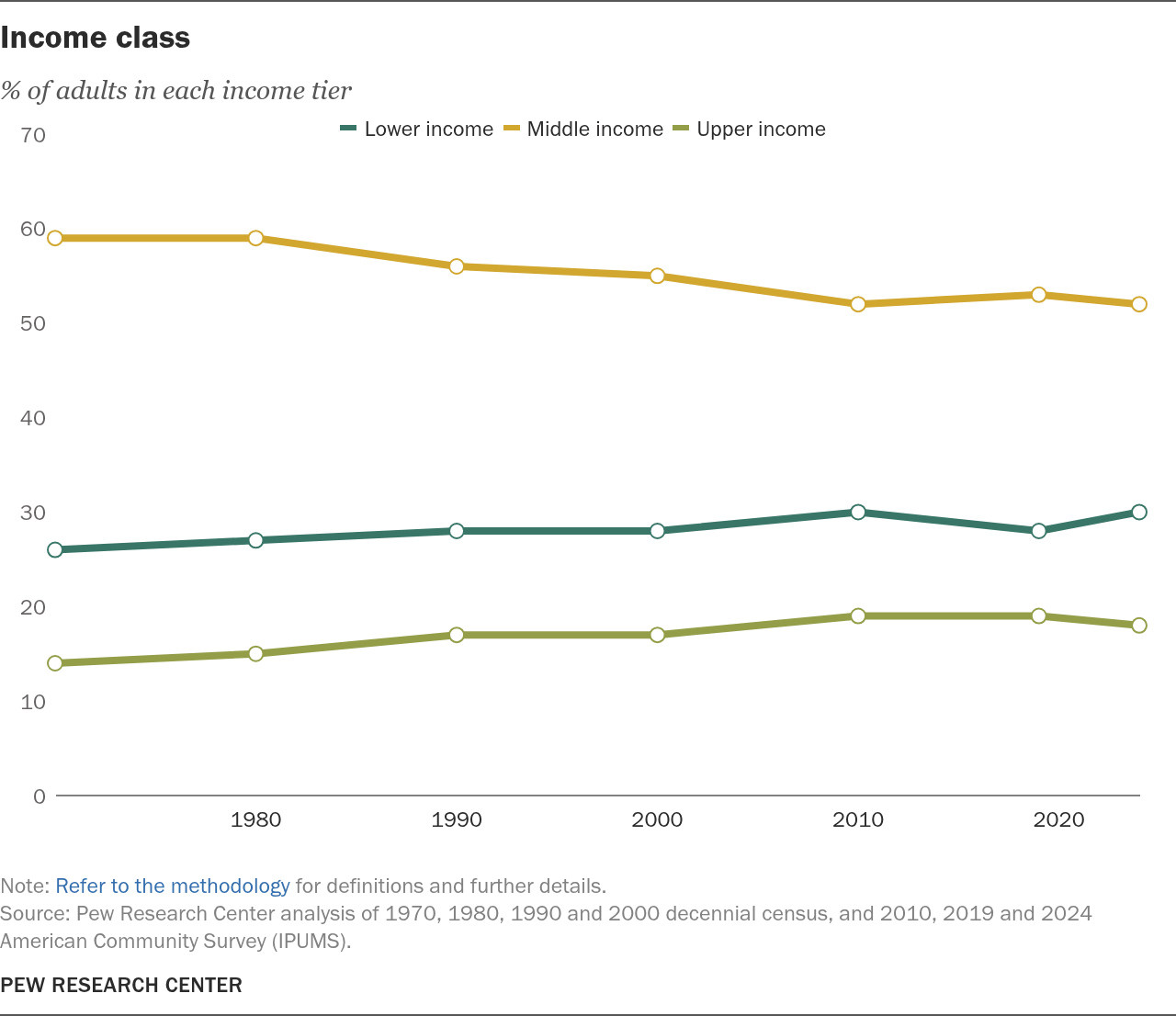 Note: Refer to the methodology for definitions and further details. Source: Pew Research Center analysis of 1970, 1980, 1990 and 2000 decennial census, and 2010, 2019 and 2024 American Community Survey (IPUMS).PEW RESEARCH CENTER
Note: Refer to the methodology for definitions and further details. Source: Pew Research Center analysis of 1970, 1980, 1990 and 2000 decennial census, and 2010, 2019 and 2024 American Community Survey (IPUMS).PEW RESEARCH CENTER
Share this chart
Income class% of adults in each income tier
| Year | Lower income | Middle income | Upper income |
|---|---|---|---|
| 1970 | 26% | 59% | 14% |
| 1980 | 27% | 59% | 15% |
| 1990 | 28% | 56% | 17% |
| 2000 | 28% | 55% | 17% |
| 2010 | 30% | 52% | 19% |
| 2019 | 28% | 53% | 19% |
| 2024 | 30% | 52% | 18% |
Download data as .csvNote: Refer to the methodology for definitions and further details. Source: Pew Research Center analysis of 1970, 1980, 1990 and 2000 decennial census, and 2010, 2019 and 2024 American Community Survey (IPUMS).PEW RESEARCH CENTER
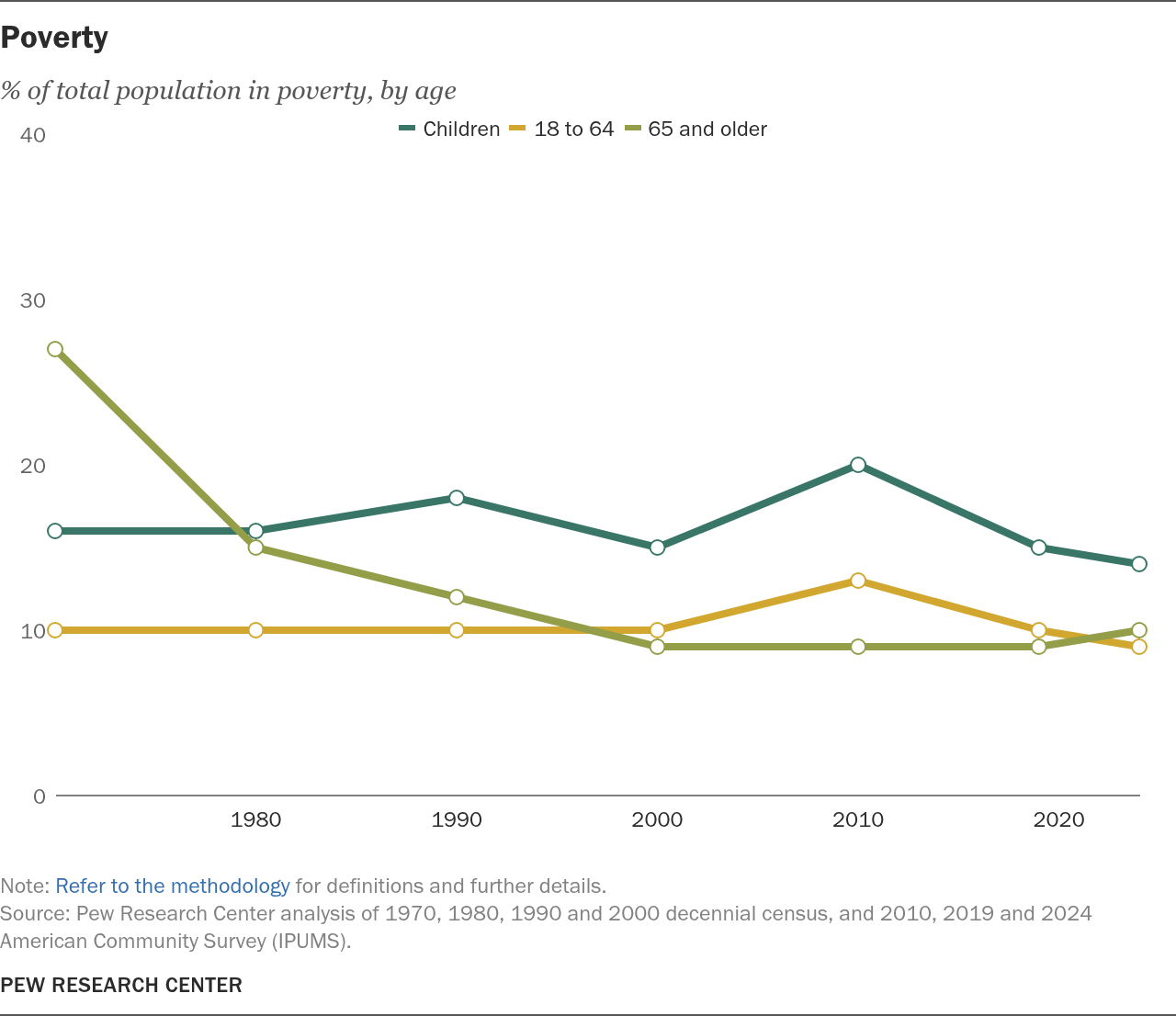
Незначне зниження рівня бідності
Частка американців, які живуть у бідності, зменшилася, особливо серед літніх людей. Дорослі, які ніколи не навчалися в коледжі, залишаються набагато більш схильними до бідності, ніж ті, хто навчався.
Poverty% of total population in poverty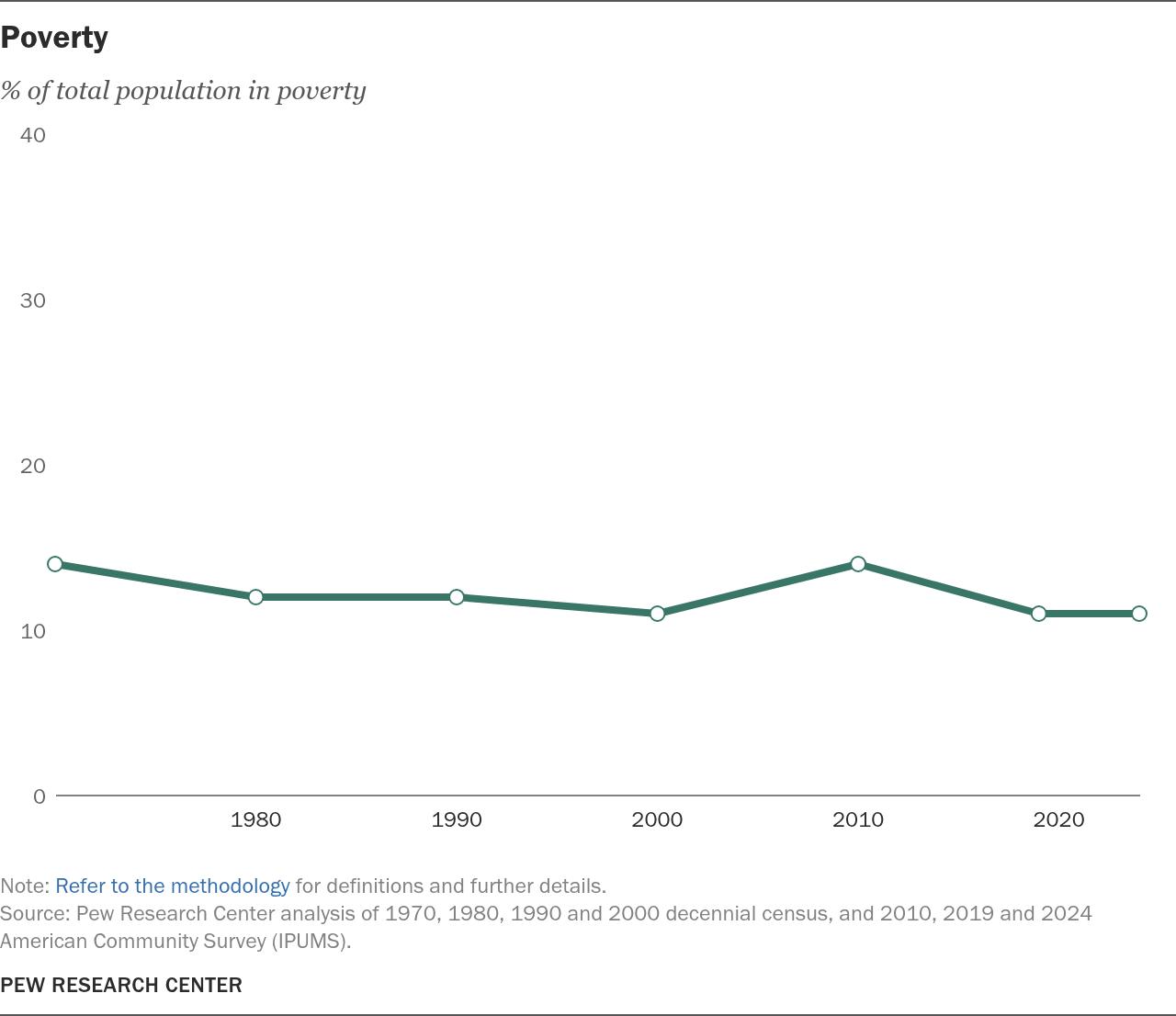 Note: Refer to the methodology for definitions and further details. Source: Pew Research Center analysis of 1970, 1980, 1990 and 2000 decennial census, and 2010, 2019 and 2024 American Community Survey (IPUMS).PEW RESEARCH CENTER
Note: Refer to the methodology for definitions and further details. Source: Pew Research Center analysis of 1970, 1980, 1990 and 2000 decennial census, and 2010, 2019 and 2024 American Community Survey (IPUMS).PEW RESEARCH CENTER
Share this chart
Poverty% of total population in poverty
| Year | All |
|---|---|
| 1970 | 14% |
| 1980 | 12% |
| 1990 | 12% |
| 2000 | 11% |
| 2010 | 14% |
| 2019 | 11% |
| 2024 | 11% |
Download data as .csvNote: Refer to the methodology for definitions and further details. Source: Pew Research Center analysis of 1970, 1980, 1990 and 2000 decennial census, and 2010, 2019 and 2024 American Community Survey (IPUMS).PEW RESEARCH CENTER
Poverty% of adults ages 25 and older in poverty, by education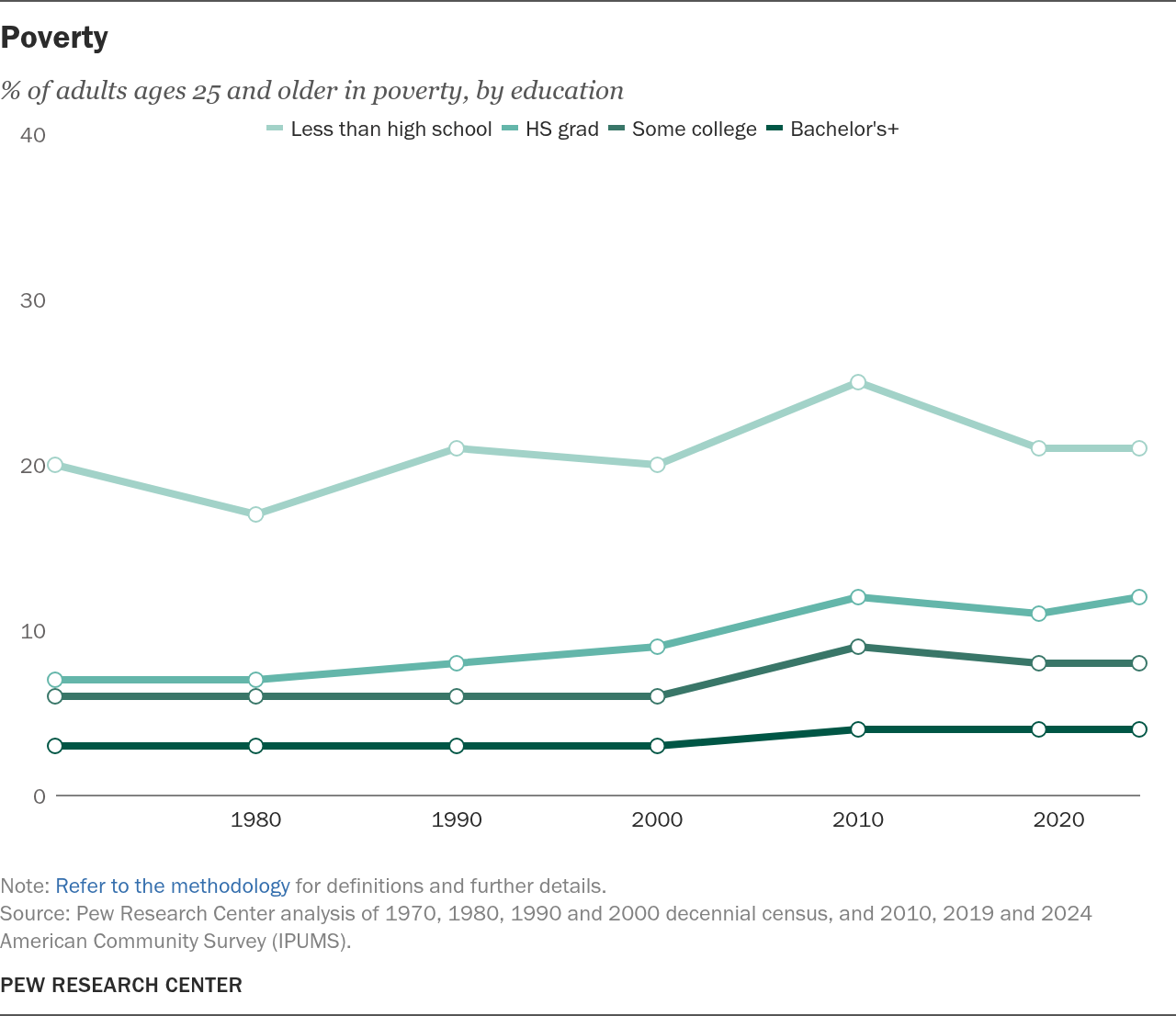 Note: Refer to the methodology for definitions and further details. Source: Pew Research Center analysis of 1970, 1980, 1990 and 2000 decennial census, and 2010, 2019 and 2024 American Community Survey (IPUMS).PEW RESEARCH CENTER
Note: Refer to the methodology for definitions and further details. Source: Pew Research Center analysis of 1970, 1980, 1990 and 2000 decennial census, and 2010, 2019 and 2024 American Community Survey (IPUMS).PEW RESEARCH CENTER
Share this chart
Poverty% of adults ages 25 and older in poverty, by education
| Year | Less than high school | HS grad | Some college | Bachelor’s+ |
|---|---|---|---|---|
| 1970 | 20% | 7% | 6% | 3% |
| 1980 | 17% | 7% | 6% | 3% |
| 1990 | 21% | 8% | 6% | 3% |
| 2000 | 20% | 9% | 6% | 3% |
| 2010 | 25% | 12% | 9% | 4% |
| 2019 | 21% | 11% | 8% | 4% |
| 2024 | 21% | 12% | 8% | 4% |
Download data as .csvNote: Refer to the methodology for definitions and further details. Source: Pew Research Center analysis of 1970, 1980, 1990 and 2000 decennial census, and 2010, 2019 and 2024 American Community Survey (IPUMS).PEW RESEARCH CENTER
Poverty% of total population in poverty, by race/ethnicity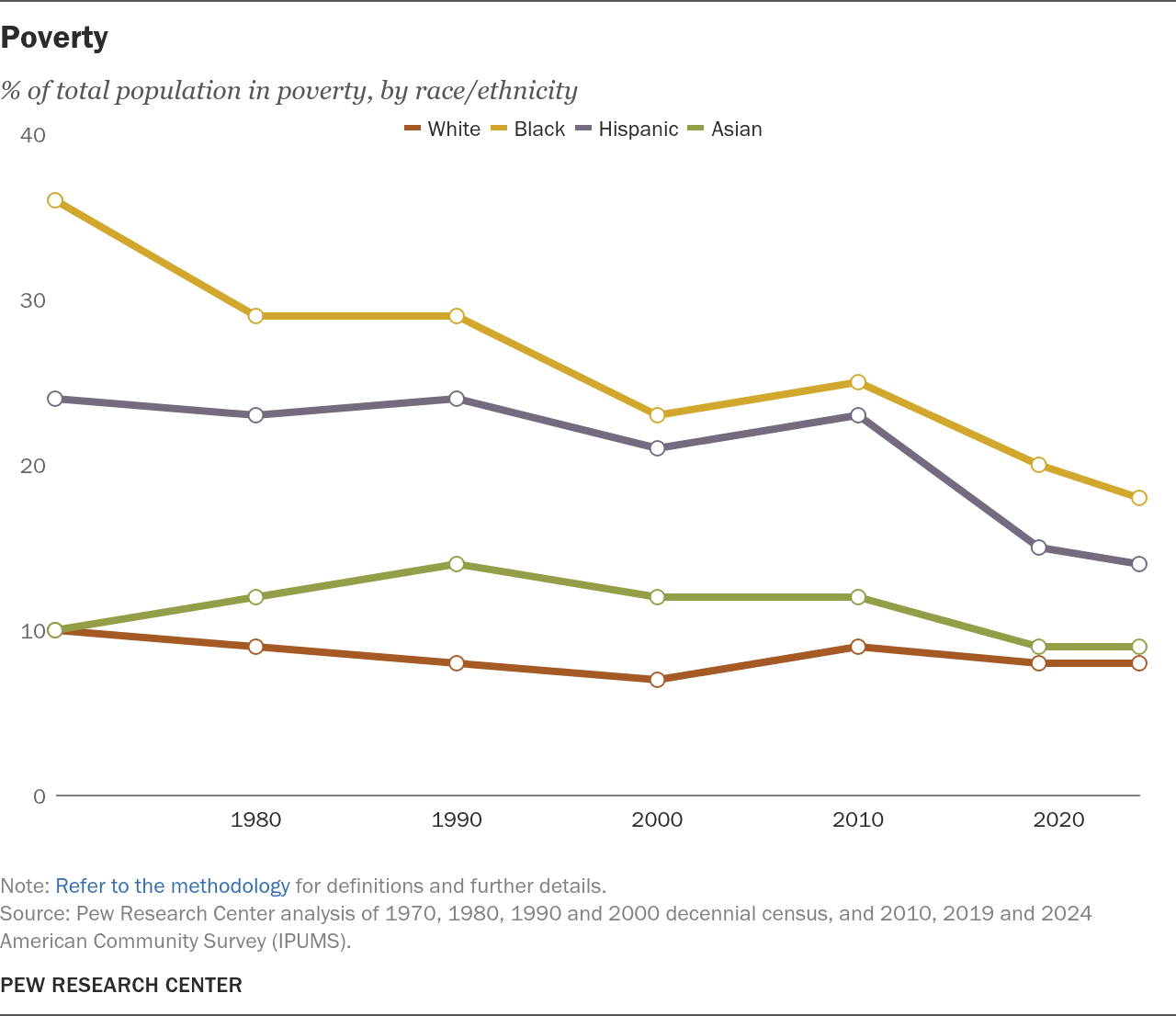 Note: Refer to the methodology for definitions and further details. Source: Pew Research Center analysis of 1970, 1980, 1990 and 2000 decennial census, and 2010, 2019 and 2024 American Community Survey (IPUMS).PEW RESEARCH CENTER
Note: Refer to the methodology for definitions and further details. Source: Pew Research Center analysis of 1970, 1980, 1990 and 2000 decennial census, and 2010, 2019 and 2024 American Community Survey (IPUMS).PEW RESEARCH CENTER
Share this chart
Poverty% of total population in poverty, by race/ethnicity
| Year | White | Black | Asian | Hispanic |
|---|---|---|---|---|
| 1970 | 10% | 36% | 10% | 24% |
| 1980 | 9% | 29% | 12% | 23% |
| 1990 | 8% | 29% | 14% | 24% |
| 2000 | 7% | 23% | 12% | 21% |
| 2010 | 9% | 25% | 12% | 23% |
| 2019 | 8% | 20% | 9% | 15% |
| 2024 | 8% | 18% | 9% | 14% |
Download data as .csvNote: Refer to the methodology for definitions and further details. Source: Pew Research Center analysis of 1970, 1980, 1990 and 2000 decennial census, and 2010, 2019 and 2024 American Community Survey (IPUMS).PEW RESEARCH CENTER
 Note: Refer to the methodology for definitions and further details. Source: Pew Research Center analysis of 1970, 1980, 1990 and 2000 decennial census, and 2010, 2019 and 2024 American Community Survey (IPUMS).PEW RESEARCH CENTER
Share this chart
Poverty% of total population in poverty, by age
| Year | Children | 18 to 64 | 65 and older |
|---|---|---|---|
| 1970 | 16% | 10% | 27% |
| 1980 | 16% | 10% | 15% |
| 1990 | 18% | 10% | 12% |
| 2000 | 15% | 10% | 9% |
| 2010 | 20% | 13% | 9% |
| 2019 | 15% | 10% | 9% |
| 2024 | 14% | 9% | 10% |
Download data as .csvNote: Refer to the methodology for definitions and further details. Source: Pew Research Center analysis of 1970, 1980, 1990 and 2000 decennial census, and 2010, 2019 and 2024 American Community Survey (IPUMS).PEW RESEARCH CENTER
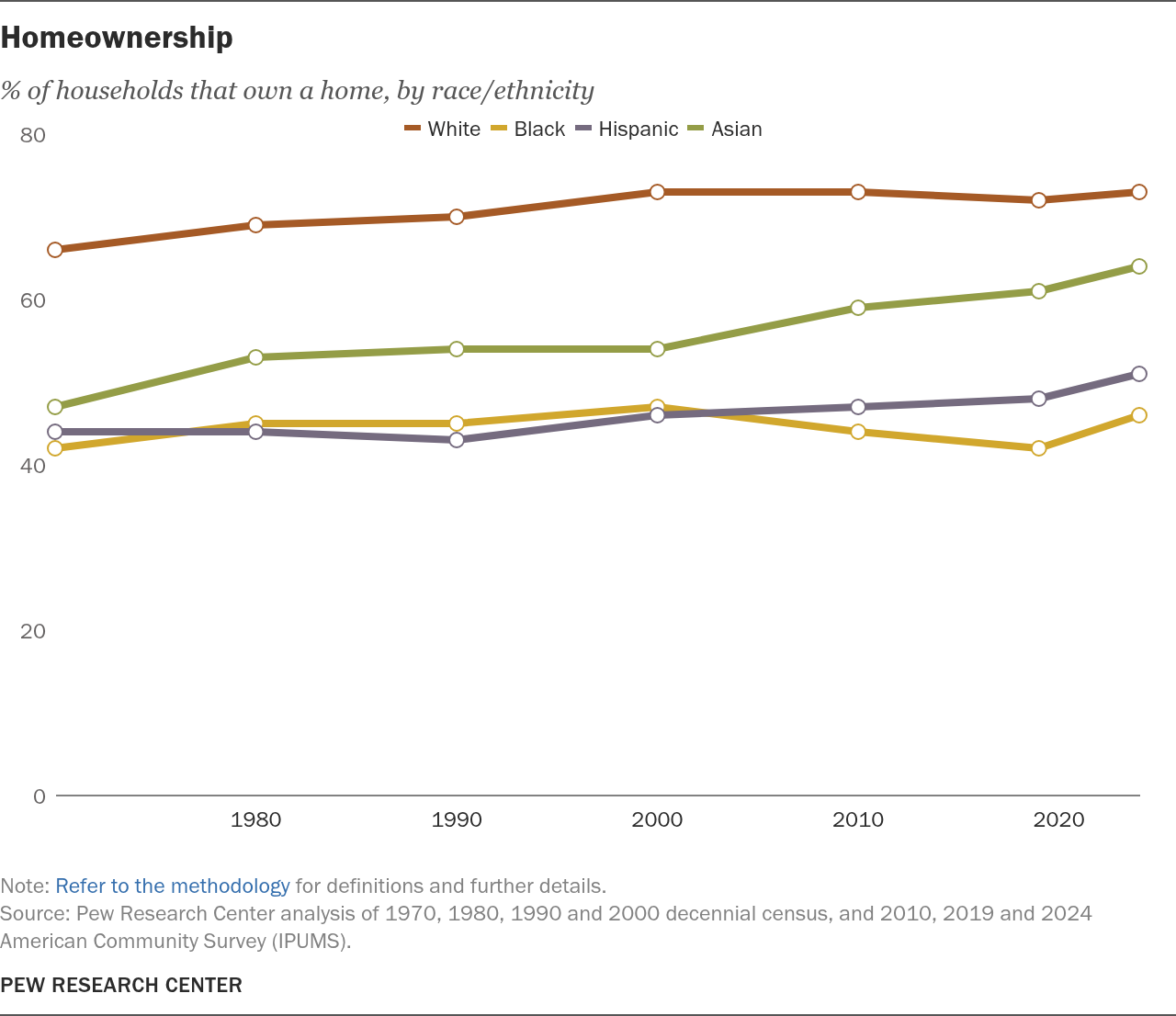
Нерівномірне зростання володіння житлом
Володіння житлом зросло лише незначно з 1970 року. Воно дещо знизилося серед дорослих віком від 18 до 64 років, але значно зросло для тих, кому 65 років і старше.
Homeownership% of households that own a home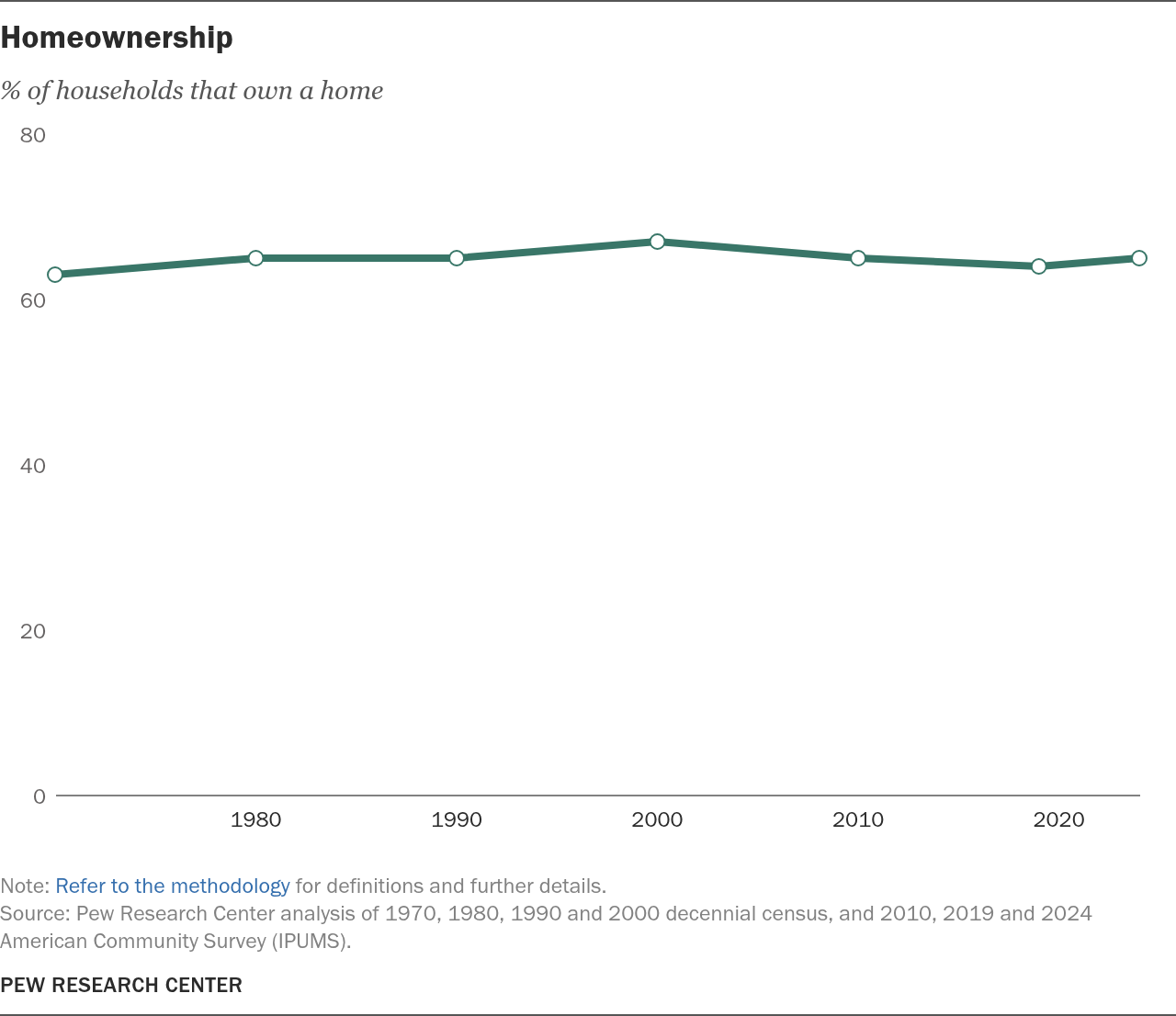 Note: Refer to the methodology for definitions and further details. Source: Pew Research Center analysis of 1970, 1980, 1990 and 2000 decennial census, and 2010, 2019 and 2024 American Community Survey (IPUMS).PEW RESEARCH CENTER
Note: Refer to the methodology for definitions and further details. Source: Pew Research Center analysis of 1970, 1980, 1990 and 2000 decennial census, and 2010, 2019 and 2024 American Community Survey (IPUMS).PEW RESEARCH CENTER
Share this chart
Homeownership% of households that own a home
| Year | All |
|---|---|
| 1970 | 63% |
| 1980 | 65% |
| 1990 | 65% |
| 2000 | 67% |
| 2010 | 65% |
| 2019 | 64% |
| 2024 | 65% |
Download data as .csvNote: Refer to the methodology for definitions and further details. Source: Pew Research Center analysis of 1970, 1980, 1990 and 2000 decennial census, and 2010, 2019 and 2024 American Community Survey (IPUMS).PEW RESEARCH CENTER
 Note: Refer to the methodology for definitions and further details. Source: Pew Research Center analysis of 1970, 1980, 1990 and 2000 decennial census, and 2010, 2019 and 2024 American Community Survey (IPUMS).PEW RESEARCH CENTER
Share this chart
Homeownership% of households that own a home, by age
| Year | 18 to 64 | 65 and older |
|---|---|---|
| 1970 | 62% | 68% |
| 1980 | 64% | 71% |
| 1990 | 62% | 76% |
| 2000 | 64% | 78% |
| 2010 | 62% | 79% |
| 2019 | 59% | 78% |
| 2024 | 60% | 79% |
Download data as .csvNote: Refer to the methodology for definitions and further details. Source: Pew Research Center analysis of 1970, 1980, 1990 and 2000 decennial census, and 2010, 2019 and 2024 American Community Survey (IPUMS).PEW RESEARCH CENTER
 Note: Refer to the methodology for definitions and further details. Source: Pew Research Center analysis of 1970, 1980, 1990 and 2000 decennial census, and 2010, 2019 and 2024 American Community Survey (IPUMS).PEW RESEARCH CENTER
Share this chart
Homeownership% of households that own a home, by race/ethnicity
| Year | White | Black | Hispanic | Asian |
|---|---|---|---|---|
| 1970 | 66% | 42% | 44% | 47% |
| 1980 | 69% | 45% | 44% | 53% |
| 1990 | 70% | 45% | 43% | 54% |
| 2000 | 73% | 47% | 46% | 54% |
| 2010 | 73% | 44% | 47% | 59% |
| 2019 | 72% | 42% | 48% | 61% |
| 2024 | 73% | 46% | 51% | 64% |
Download data as .csvNote: Refer to the methodology for definitions and further details. Source: Pew Research Center analysis of 1970, 1980, 1990 and 2000 decennial census, and 2010, 2019 and 2024 American Community Survey (IPUMS).PEW RESEARCH CENTER
Подяки
Цей інтерактивний інформаційний бюлетень був написаний провідним економістом Річардом Фраєм, провідним демографом Джеффрі Пасселом та науковим співробітником Джейком Хейсом. Редагування здійснила провідний автор/редактор Далія Фахмі. Аналіз кількості дітей провів аналітик-дослідник Дана Брага.
Науковий співробітник Луїс Ное-Бустаманте, аналітик-дослідник Кайлі Херст та науковий асистент Блен Вондіму перевірили текст.
Дизайнер інфографіки Джон Карло Мандапа та цифровий продюсер Рім Надім зробили внесок у виробництво.
Кім Паркер, директорка з досліджень соціальних тенденцій; Джуліана Горовіц, заступниця директора з досліджень соціальних тенденцій; Марк Х’юго Лопес, директор з досліджень расових та етнічних питань; та Сахана Мукерджі, заступниця директора з досліджень расових та етнічних питань, надали концептуальне керівництво та нагляд.
Таня Ардіті, менеджерка з комунікацій, наглядала за поширенням інформації.
За даними порталу: www.pewresearch.org